“I was happy when I walked the streets of Paris by myself.”

Featured

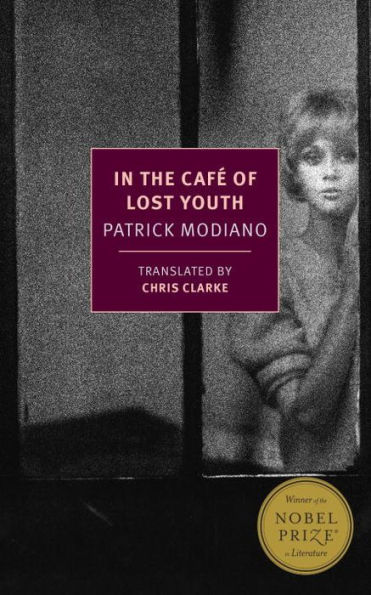
On Wednesday, 18 February, 2026, Another Look will present Nobel prizewinning Patrick Modiano’s 2007 novella, In the Café of Lost Youth (New York Review Books). The event will take place, as always, at 7 p.m. at Levinthal Hall, 424 Santa Teresa Street on the Stanford campus.
Panelists will include Stanford Prof. Robert Pogue Harrison, author, director of Another Look, host of the radio talk show and podcast series Entitled Opinions, and a regular contributor to The New York Review of Books, and Stanford Prof. Tobias Wolff, one of America’s leading writers and the founding director of Another Look, as well as a recipient of the National Medal of Arts. 

They will be joined by Chloe Edmondson, a lecturer in Stanford’s Department of French and Italian. She is the France-Stanford Center Fellow for the Roxane Debuisson Collection on Paris History. You will remember her from our event Madame de LaFayette’s The Princesse de Clèves in 2019. Actor, director, classicist, Stanford Prof. Rush Rehmwill round out the panel. (You will remember Rush from our 2016 event on Joseph Conrad’s The Shadow-Line: A Confession.)

The Nobel announcement recognized Modiano’s “consistent exploration of memory and the elusive nature of personal history, often set against the backdrop of occupied Paris.”
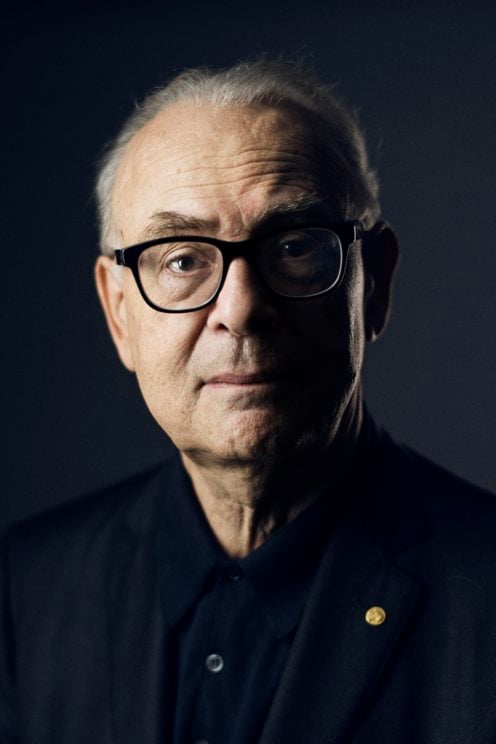
He has been praised for his “subtle, clear style and his ability to bring anonymous lives to light, making him a modern-day Proust in the eyes of some.”

According to World Literature Today, “Modiano’s fictional world is not postapocalyptic, like the fictional worlds of Beckett, but postrelational . . . a world where familiar patterns, whether placed in memory, neighborhoods, or situations, are dispersed and left to languish on the wind.”

Meanwhile, Another Look has done a Q&A interview with Modiano’s translator, Chris Clarke. You can read: “No one saw the Nobel coming”: A Q&A with Modiano’s translator on the Another Look website.

You can register for the event on the link below – and please share the link (and the poster and event square we’ve attached) with your friends:

https://stanford.zoom.us/webinar/register/WN_-03yUMbsSWWwJdijPIQg3w#/registration

Bonus reading: 

Nobel lecture:
https://www.nobelprize.org/prizes/literature/2014/modiano/lecture/

Nobel Award speech:
https://www.nobelprize.org/prizes/literature/2014/ceremony-speech/

In the Café of Lost Youth is on order at Kepler’s and should arrive shortly. Call 650-324-4321 to reserve a copy.

“We will become masters of the world!”

Featured

Please join us at 7 P.M. (PST) on Thursday, April 17, when Another Look presents Dino Buzzati’s 1960 The Singularity. The hybrid event will take place in Levinthal Hall at the Stanford Humanities Center at 424 Santa Teresa Street on the Stanford campus.

The Singularity, originally published in 1960, probes some of the deeper human questions surrounding artificial intelligence. It was republished last year in a new translation from the Italian by Anne Milano Appel for New York Review Books.

Will Dunn, writing in The New Statesman, called it “a stylish, compelling little mystery” that, although more than six decades old, “predicts … with unsettling accuracy. Its characters are confronted by the presumptuous arrogance of men whose brilliance in engineering disguises how morally and emotionally incapable they are.”

Kevin Brockmeier, writing in Electric Literature, called Buzzati “one of the great literary practitioners of the dark marvelous … one corner iin the triangle of indispensable twentieth-century Italian fantasists, along with Italo Calvino and Tommaso Landolfi.

Panelists will include Stanford Italian Prof. Robert Pogue Harrison, author, director of Another Look, host of the radio talk show and podcast series Entitled Opinions, and a regular contributor to The New York Review of Books, and Stanford Prof. Tobias Wolff, one of America’s leading writers and the founding director of Another Look, as well as a recipient of the National Medal of Arts.

We have two guest panelists as well:

Stanford Associate Prof. Laura Wittman, is a specialist in modern Italian literature. Some of you will remember her from our 2018 event on William Henry Hudson’s Green Mansions.

Bryan Cheong received his Bachelor of Science from Stanford University with a degree in applied and computational mathematics before receiving a Masters in Materials Science, also from Stanford. For the past few years he’s been working in the high-tech sector of Silicon Valley.

Register for the event here:

https://stanford.zoom.us/webinar/register/WN_3FhvEX50TvmwwLc_ou0uag


While walk-ins are always welcome, we encourage registration for both zoom and in-person attendance.

Kepler’s in Menlo Park will be carrying the book for us – you get a 15% discount at the register.

Buzzati was also a painter and journalist.

“A moralizing scientific fable written in the spirit of Diderot”

Featured

Stanford will be featuring an “Another Look” discussion of Dino Buzzati’s 1960 The Singularity on Thursday, April 17in Levinthal Hall at the Stanford Humanities Center at 424 Santa Teresa Street on the Stanford campus. Register for the event, whether on zoom or in person, here.

Meanwhile, in preparation for the event, Another Look director, Stanford Prof. Robert Pogue Harrison, interviewed Edwin Frank, director of New York Review Books and the founder of the NYRB series. Enjoy!

Robert Pogue Harrison: Congratulations on rescuing Buzzati’s remarkable novel from oblivion. Almost none of my literary friends in Italy had heard of it before I mentioned that a new English translation has recently been published by NYRB. Now it seems that Amazon Italy has made it available on demand, no doubt because of the attention the book is receiving in the USA. May I ask how this book first came to your attention?

Edwin Frank: I don’t exactly recall who alerted me to the existence of the book. It may have come through our readers recommendations page, and I read it in the old translation.

Harrison: In Italian the book is called Il grande ritratto (“The Great Portrait”). The English title has little if anything to do with the original title. Why did you and Anne Milan Appel (an excellent translator) decide to call it “The Singularity”?

Frank: Buzzati’s title makes it clear that the book is, as so many of his books are, more about checkered love than science and consciousness, but the years since have given it an added dimension of significance, and Anne and I hoped to underline this with the title change.

Harrison: The story does not have a happy ending. Do you think that’s because some of the main characters are misguided in their ambitions, or because Dino Buzzati was wary about the direction the new technologies were headed in his time?

Frank: It is a curious instance of a moralizing scientific fable written in the spirit of, say, Diderot, taking on a dimension of prophecy, but it is not alone in that.

Harrison: Around the time Buzzati wrote The Singularity, Martin Heidegger declared: “No prophecy is necessary to recognize that the sciences now establishing themselves will soon be determined and regulated by the new fundamental science that is called cybernetics,” yet he was in fact prophetic when he said that. Do you think Buzzati was equally prophetic when he wrote this astonishing novel?

Frank: The unhappy ending also has a double valence: if it picks up on Wilde’s “Each man kills the one he loves” (and only doubles down on the misdeed if, as in this story, he seeks to reverse that outcome), now we can see it as reflecting a fundamental misapprehension on the part of science about the nature of personhood, one that gives us that much more opportunity to misunderstand one another.

Don’t forget to register for the event, whether on zoom or in person, here.

Join us for Jun’ichirō Tanizaki’s 1933 classic “In Praise of Shadows” on April 29!

Featured

Please join us for a discussion of Jun’ichirō Tanizaki‘s 1933 classic In Praise of Shadows. Another Look will discuss Tanizaki’s 73-page essay at 7 p.m. (PST) on Monday, April 29, at Levinthal Hall in the Stanford Humanities Center at 424 Santa Teresa Street on the Stanford campus. This is a hybrid event, so you can come in person or via zoom, but we encourage you to register either way here or on the link below.

Panelists will include Stanford Prof. Robert Pogue Harrison, author, director of Another Look, host of the radio talk show and podcast series Entitled Opinions, and a regular contributor to the New York Review of Books, and three special guests: Mark Gonnerman, who has a Stanford PhD in religious studies, has been a student of Japanese histories and cultures since he first ventured to Kyoto in the mid-1970s. Meri Mitsuyoshi is a longtime Another Look aficionado whose appreciation of Japanese aesthetics is informed by study of ritual and intergenerational cultural transmission.

Rounding out the panel: Ethen Wood, the associate director of Stanford’s Sustainable Architecture + Engineering. For eleven years, he has taught architectural design studio courses and co-taught courses on Japanese modern architecture. In addition, he has his own architectural design office in San Francisco. He grew up in San Francisco’s Zen Buddhist community in the 80’s and spent part of his childhood in a Zen Buddhist monastery in the mountains of Carmel, without electricity. “This was part of a concerted effort by the temple to stay true to the traditions and historic experiences from Japan,” he said.

“In his delightful essay on Japanese taste Junichiro Tanizaki selects for praise all things delicate and nuanced, everything softened by shadows and the patina of age, anything understated and natural – as for example the patterns of grain in old wood, the sound of rain dripping from eaves and leaves, or washing over the footing of a stone lantern in a garden, and refreshing the moss that grows about it,” writes A.C. Grayling in The Guardian. “Tanizaki’s relish in the world and its ordinary pleasures offers a sharp contrast to the functional, plastic, disposable aesthetic of modern western life.”

This isn’t the first time Another Look discusses an essay – our discussion of Virginia Woolf‘s A Room of One’s Own got worldwide attention. We hope Tanizaki’s consideration of Japanese architecture and aesthetics generates the same enthusiasm. Tanizaki (1886-1965) was nominated several times for a Nobel prize, and was on the final shortlist in the year before his death. Youtube video here discusses his life and his book.

This event is sponsored by the Stanford Division of Literatures, Cultures, and Languages and the Continuing Studies Program at Stanford, and the Stanford Humanities Center.

https://stanford.zoom.us/webinar/register/WN_ZeL5ynQVQnW6JZzrvhbHFg#/registration

A full house and a lot of audience questions for Melville’s “Bartleby”!

Featured

Another Look had a full house on Monday, January 8, as we explored Herman Melville‘s 1853 classic story Bartleby, the Scrivener: A Story of Wall Street. Every seat was taken – literally, every one – with hundreds more of you at home, watching on zoom. The discussion was insightful, lively, and engaging …. and seemed to go on forever. Thank you all for your questions. We regret that we didn’t have time to answer them all.

Another Look director Robert Pogue Harrison
Tobias Wolff

Panelists included Stanford Prof. Robert Pogue Harrison, author, director of Another Look, host of the radio talk show and podcast series Entitled Opinions, and a regular contributor to the New York Review of Books, and Stanford Prof. Tobias Wolff, one of America’s leading writers and the founding director of Another Look, as well as a recipient of the National Medal of Arts. Two special guests rounded out the high-powered panel out to four: Robert’s brother Thomas Harrison, professor of European Languages and Transcultural Studies at the University of California, Los Angeles, and Katie Peterson, an award-winning poet and professor of English at UC-Davis, and a Stanford alum.. You can see them in the photo above, taken by Another Look fan and photographer David Schwartz.

Now you have a chance to see it again – or for the first time if you missed it. The video is here, and the podcast is here. It’s certainly a discussion that would merit “another look.”

What did you think? Feel free to comment on the book or the discussion. Meanwhile, we had so many questions! Here’s a few we didn’t get a chance to ask our panelists. You can reply to them in the comments section below.

Katie Peterson
Thomas Harrison
  1. Bartleby never said ‘no’, he always preferred not to. And yet nobody ever challenged him to make a more clear response. Do we learn anything by the narrator’s never choosing to challenge the equivocation?
  2. Isn’t it more illuminating to see Bartleby as existing within the narrator, as a product of the lawyer’s decision to live an easy life, as a double of the lawyer — as his unconscious. A no-saying of the unconscious that can’t be explained or penetrated. 
  3. At the same time, isn’t Bartleby a vision of the power of nihilism, a silent cousin of the “Underground Man” ten years later, created out of the same interest of Melville’s as Dostoevsky’s in the nature of meaning in a world where God is rejected.
  4. It struck me that Bartleby was in some ways like a Rorschach inkblot test – onto which the narrator projects a changing array of attempted interpretations. But for someone who seems to have made a living by writing (if as an automaton rather than a ‘creative’ writer), Bartleby is unintelligible, unreadable – provoking the narrator’s and the audience’s speculations about what he might be or mean. So in some ways, is the story about the impossibility of both interpretation itself and interpretation of the inner lives of other people? By the way, postal “dead letter” offices deal with all undeliverable mail – not just mail addressed to people who have died.
  5. I agree that with the earlier comment that Bartleby lacks generosity. I found it disconcerting that the compassion shown by the narrator to Bartleby was not in the least returned.  When the narrator seeks out Bartleby in the Tombs, Bartleby says without looking around “I know you”… and I want nothing to say to you”.  I’m curious if the panelists also think this is quite harsh.
  6. Do you believe Melville meant Bartleby to be a direct critique of Thoreau and his fellow Transcendentalists?
  7. Bartleby was written before Melville’s Moby Dick and decades before his Billy Budd. [Moby Dick was published in 1851, Bartleby in 1853, Billy Budd was unfinished at his death in 1891 – ED.] All three narratives center on a character who is a standout or outlier from the mass of humanity. That apparently was a theme that Melville could not resist, and my question is: What was Melville driving at by looking so fully at these strange people? What was his obsession about them?
  8. Fortunately we know lawyers today are much more creative, interesting and imaginative than simple copyists as in the story.  We are artists in our way. Give us some grace.
  9. any reflections on the story as a modern day allegory to quiet quitting? or more specifically, doing what is on the job description only?
  10. Do you see parallels between Bartleby’s incessant “I prefer not to” and Poe’s Raven’s “Nevermore”: neither will leave, nor will they explain…
  11. The magazine The Economist has a Bartley by weekly column under its business section each week… it’s still relevant…John in Singapore

Finally, someone sent us Melviille’s poem “Buddah”:

Swooning swim to less and less,
. Aspirant to nothingness!
Sobs of the worlds, and dole of kinds
. That dumb endurers be –
Nirvana! absorb us in your skies,
. Annul us into thee.

Another Look celebrates its 10th anniversary with Wescott’s Pilgrim Hawk and a high-spirited conversation!

Featured

Another Look director Robert Pogue Harrison introducing the event. (All photos by David Schwartz)

Another Look celebrated its tenth anniversary with another remarkable and too-little-known masterpiece: Glenway Wescott‘s 1940 novella The Pilgrim Hawk: A Love Story (NYRB Classics). And what a lively celebration it was! The Wednesday, October 5, conversation was spirited, controversial, and occasionally downright rowdy.

The panelists: Steve Wasserman, former book editor at the Los Angeles Times Book Review and editor at large for the Yale University Press, and now publisher of Heyday Books in Berkeley; Stanford Prof. Robert Pogue Harrison, author, director of Another Look, host of the radio talk show and podcast series Entitled Opinions, and a regular contributor to the New York Review of Books; Stanford Prof. Tobias Wolff, one of America’s leading writers, is the founding director of Another Look and a recipient of the National Medal of Arts; and author Cynthia L. Haven, a National Endowment for the Humanities public scholar.

You can view the video version of The Pilgrim Hawk: A Love Story here – or listen to the podcast here.

The occasion also marked our return to our long-ago beginnings. We held our inaugural event at Levinthal Hall in the Stanford Humanities Center for William Maxwell’s So Long See You Tomorrow in 2011. We outgrew that friendly and intimate setting seven years ago, on June 1, 2015. The occasion? Another Look took on Albert Camus‘s The Stranger.

On that astonishing evening, we filled the hall to the bursting point, with Another Look friends sitting on the floor and crowding the doorways. The size of the event had surprised even us, and necessitated a move to the more spacious Bechtel Conference Center in Encina Hall. Now we’re changing venues again. COVID inaugurated the era of zoom: now Another Look offers hybrid events – a virtual presence for those who live across the country, world, or who, for other reasons, have to stay close to home, along with our traditional in-person events, where you can chat with the panelists and enjoy the energy of a lively literary discussion.

The reason for the crowd that June night in 2015: Another Look’s founding director Tobias Wolff had just announced his retirement, and it looked like that would be the end of Another Look. But it was also the night Prof. Robert Pogue Harrison, who was in the audience that night (some will remember his spirited exchange with Toby on The Stranger), stepped forward to fill Toby’s shoes. Now the two directors team up on the panel for most of our events – and what a great duo they are! Thanks to our night with Camus, we continued a full decade of events for a program that is perhaps unique in the nation – including the most recent presentation of Glenway Wescott’s brilliant novella.

The Pilgrim Hawk: A Love Story traces a single afternoon in a French country house during the 1920s. Alwyn Tower, an American expatriate and sometime novelist, is staying with a friend outside Paris when a well-heeled Irish couple drops in — with Lucy, their tamed hawk, a restless, disturbing presence. The story that unfolds is both harrowing and farcical. Novelist Michael Cunningham in his introduction calls the book “murderously precise and succinct.” 

A bonus: NYRB publisher Edwin Frank, a former Stegner fellow at Stanford and a longtime supporter of Another Look, contributed to our fête with an interview about The Pilgrim Hawk: A Love Story. The Q&A “Subtlety and ferocity, despair, and some genuine camp” is here.

Photos below taken by Another Look photographer David Schwartz, working virtually from home. Thanks, David! This Another Look also marks another transition: Roger Winkelman, who did a heroic job film and recording our events at Bechtel and became a treasured member of the Another Look family, has retired and moved to New York. His colleague. Robert Edgar, has taken up the challenge of guiding Another Look into its second decade. Welcome, Bob!