
 Marilyn Yalom is a feminist author and historian. She is a senior scholar at the Clayman Institute for Gender Research at Stanford University, which she co-founded. She is also a French scholar, and the author of the acclaimed How the French Invented Love (Harper Collins, 2012).
Here is a short excerpt from her early article, “Albert Camus and the Myth of the Trial,” published by Modern Language Quarterly in 1964:
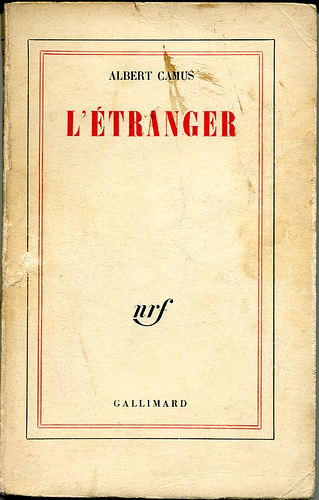 The trial of L’Etranger, undoubtedly indebted to Kafka’s trial, ultimately constitutes a rejection of the Kafkaesque Weltanschauung, according to which the shame of submission lingers on after an ignominious death. The youthful Camus, romantic rebel championing the outcast individual, indicts society and reserves for his hero the sleep of the innocent. That the more mature Camus could not so easily dismiss the Kafkaesque vision is clearly revealed in La Chute. Before turning to this later work, I should like to examine the trial situation as Camus presents it in L’Etranger, La Peste, and La Chute; for the manner in which he transforms this situation to suit its new habitat gives us an insight into the development of his views on the nature of guilt.
During the trial scene of L’Etranger, a young journalist fixes his attention upon Meursault with such intensity that he gives the defendant the impression of being observed by himself. Although there are only five short references to this character within the novel, the fact that Meursault searches out his eyes at significant moments of the trial suggests his importance. The reader is left with the impression of a silent, sensitive young man who conveys his compassion for the defendant, in contrast to the callous assembly concerned with passing judgment.
In La Peste one of the principal characters, Tarrou, who aspires to be “un saint sans Dieu” recounts a courtroom incident that changed the direction of his life. At the age of seventeen, Tarrou for the first time saw his father exercise his profession of advocate-general. The young Tarrou is immediately drawn to the person of the defendant – a sorry-looking wretch with the air of a frightened owl – rather than to that of his father, and he spends the major part of the trial in silent observation of the accused man. As in the case of the journalist and Meursault, Tarrou and the condemned man experience through their silent communication “une intimate . . . vertigineuse” verging upon communion.
With the discovery that it is his father who demands and wins the death sentence, Tarrou experiences a profound and permanent sense of revulsion, which subsequently compels him to leave home in order to avoid becoming “un pestiféré” like his father. As Tarrou explains it in the allegorical language of La Peste, the world is divided into “des fléaux et des victimes”; those who add to natural injustice the human injustice of legalized murder belong to the first category. Tarrou’s personal decision to expiate the sins of his father by siding with the victims does not obliterate the hope that a reconciliation between the two groups may be arrived at through “la sympathie.”
“La sympathie,” that pregnant word which can be rendered in English only by a combination the basis for une morale de sentiment not unlike Rousseau’s pitié. Those in La Peste who manifest this quality – Tarrou, Rieux, Joseph Grand, even the later Othon – experience a certain moral strength, which is the mark of salvation in the world of Camus. The petty criminal Cottard and the priest Paneloux, each of whom in his own way profits from human suffering, remain “cas douteux.” For those “grands pestiférés, ceux qui mettent des robes rouges” and who have replaced sympathie with institutionalized judgment, there is no salvation.
The sentiment of sympathie experienced by a courtroom observer for a man condemned to death furnishes one clear link between La Peste and L’Etranger; indeed, the definition of the condition needed to experience sympathie – “l’idée nécessaire que le sujet souffrant est un semblable, un autre soi-meme” – provides a meaningful commentary on Meursault’s feeling that he is being observed by himself.