
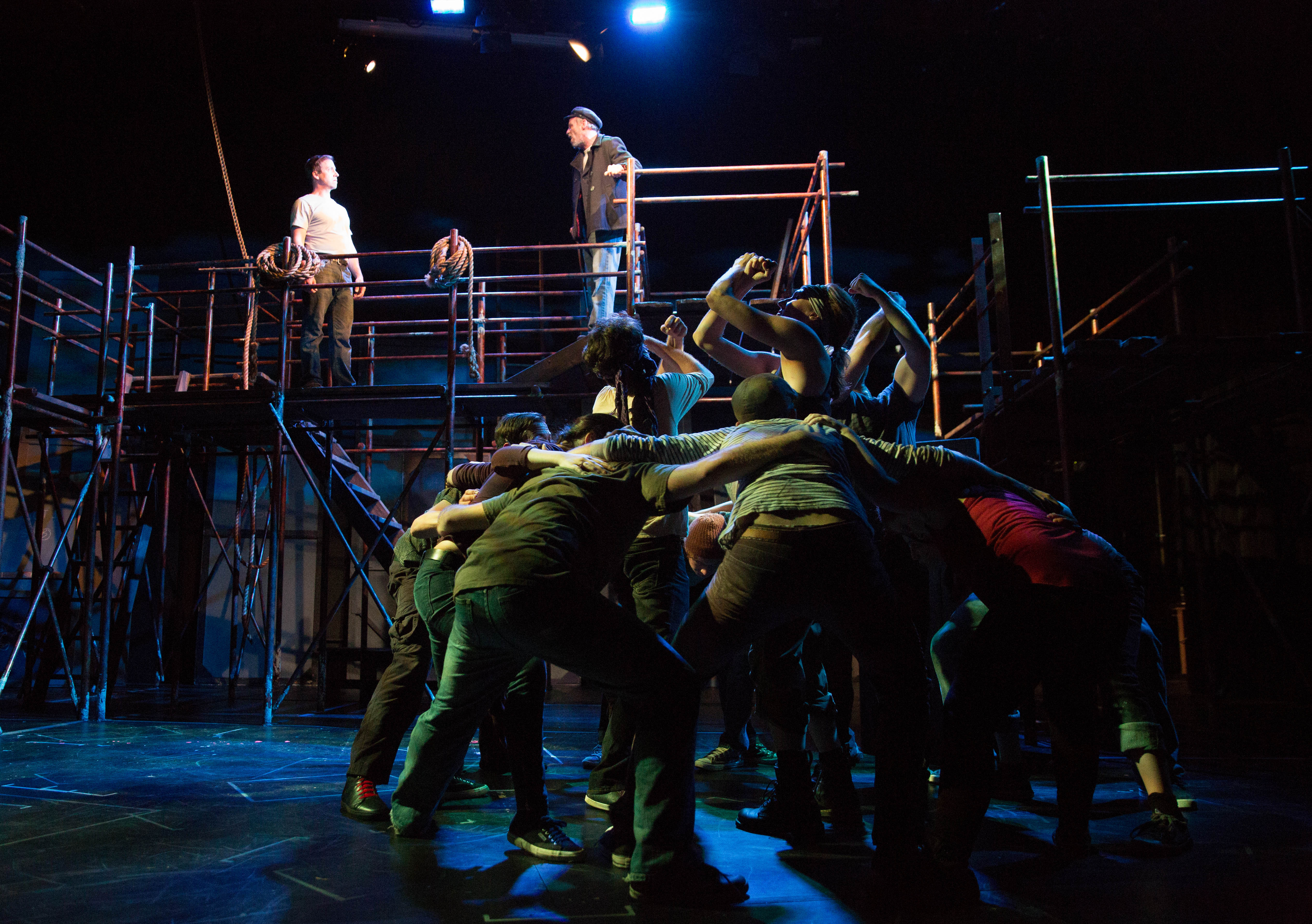
From the 2014 SRT’s production of “Moby Dick – Rehearsed”
In 2014, Drama Prof. Rush Rehm directed the rarely performed Moby Dick – Rehearsed, Orson Welles’s adaptation of Melville’s novel. (A terrific show – read about it here.) We thought Rehm, the founding director of the Stanford Repertory Theater and one of the panelists for our May 10 event on The Shadow-Line, might have some thoughts as an actor and director about Conrad’s short novel and Melville’s long one – both about disasters at sea – plus some thoughts about The Shadow-Line more generally. What he said: 
The Stanford Repertory Theater staged Moby Dick – Rehearsed two summers ago. Both of course are set on sailing ships and the sea, but Conrad’s story lacks (purposely) a specific goal or end. No white whale in The Shadow Line! As you know, the arrival of the ship through the doldrums and storm only marks one stage in the narrator’s journey, as he enlists a new crew for what lies ahead. The very shadow-quality of the quest in Conrad’s story suggests something of the mystery of crossing into adulthood, of growing into age. In this sense, the story lacks the clarity of arrival and certainty of discovery and attainment that defines narratives with a more romantic bent. Conrad’s hero clearly has gone through, endured, and learned from an extraordinary set of experiences, but his arrival is to a place where the compulsions are to carry on, not to revel in arrival or settle for whatever one can glean from what has past.