Why Sara van Fleet and Wensleydale?

That rose, Sara van Fleet … I still have it. Pressed in a book. My Bannister-Fletcher, as a matter of fact. Someday, after a sale, a stranger will find it there and wonder why.

As Alice Keach said to Tom Birkin, “Sara van Fleet isn’t any old rose” – but why did J.L. Carr pluck this particular flower for his heroine?

Sara van Fleet is of the rugosa variety – that makes it one of the oldest and hardiest roses still in existence. A drawing by Chao Ch’ang, active around 1,000 A.D., features one. They were brought to Europe from Asia in 1784.

More importantly for literary purposes, it is one of the most richly scented roses. One specialist praised it as having “a contralto scent in contrast with the Tea’s soprano.” That means its linger with Tom Birkin in more than memory.

Along with the China Rose, it is pretty much alone in producing flowers from May to October. Alice Keach told us so:

“Sara van Fleet,” she said. It was a pink rose, a single. “It’s an old variety. Mind! It has sharp thorns. And it keeps on blooming. You’ll see  – there’ll be some right into autumn.” She smiled. “Even if you don’t visit us again, you’ll know – I usually wear one in my hat … Here, take one.”

 ***

Tom Birkin is quite specific about his eating habits: “I was going to be happy, live simply, spend as little as paraffin, bread, vegetables and a bit of bully-beef now and then might cost me. I could have managed on a couple pints of milk a week, but this weather it wouldn’t keep so I should have to have three: oatmeal porridge is very sustaining and needs only warming to make a second meal.” Bully-beef is a kind of corned beef, and it’s useful to remember that this was the time before refrigeration and, for most rural housing, before indoor plumbing. “Each day still began much alike. I brewed up, fried a couple of rashers and a round of bread…” Rashers are thin slices of bacon.
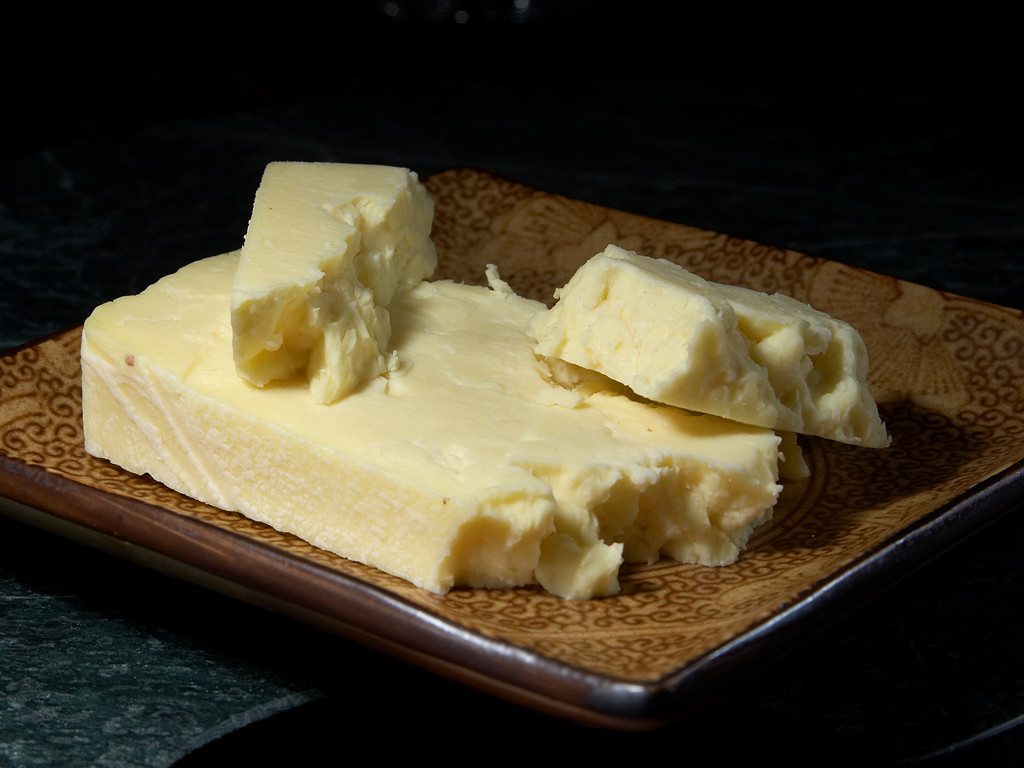
More than once, he tells us: “I usually cut two rough rounds of loaf and a wedge of Wensleydale and took it outside to eat.” But what is Wensleydale? The choice of this white, crumbly cheese gives us some notion of where the fictional Oxgodby is situated – for the cheese would not traveled more than a few miles from the small village of Wensleydale, situated in the upper valley of the River Ure in North Yorkshire. The cheese was first made by medieval Cistercian monks from France – and so has an unusual harmony with the work that occupied Tom Birkin by day. In Yorkshire, one has Wensleydale with apple pie in the summer, with Christmas cakes in the winter.

But the porridge and bully-beef, the antique roses and a well-known cheese associated with Yorkshire, make a bigger point: this is an England that was disappearing by time Carr published his book in the 1980. Carr conjures these disappearing  markers of British life, preserving them in the perfect world of 1920s Yorkshire he recreates for A Month in the Country. 
“Thoo’s ga-ing ti git rare an’ soaaked reet doon ti thi skin, maister.”

The renowned Yorkshire dialect is almost as exotic to a Londoner as it is to those on this side of the Atlantic. Hence Tom Birken’s puzzled reaction to his fellow passenger’s warning on the train that marked his entry into Oxgodby: “Thoo’s ga-ing ti git rare an’ soaaked reet doon ti thi skin, maister.”

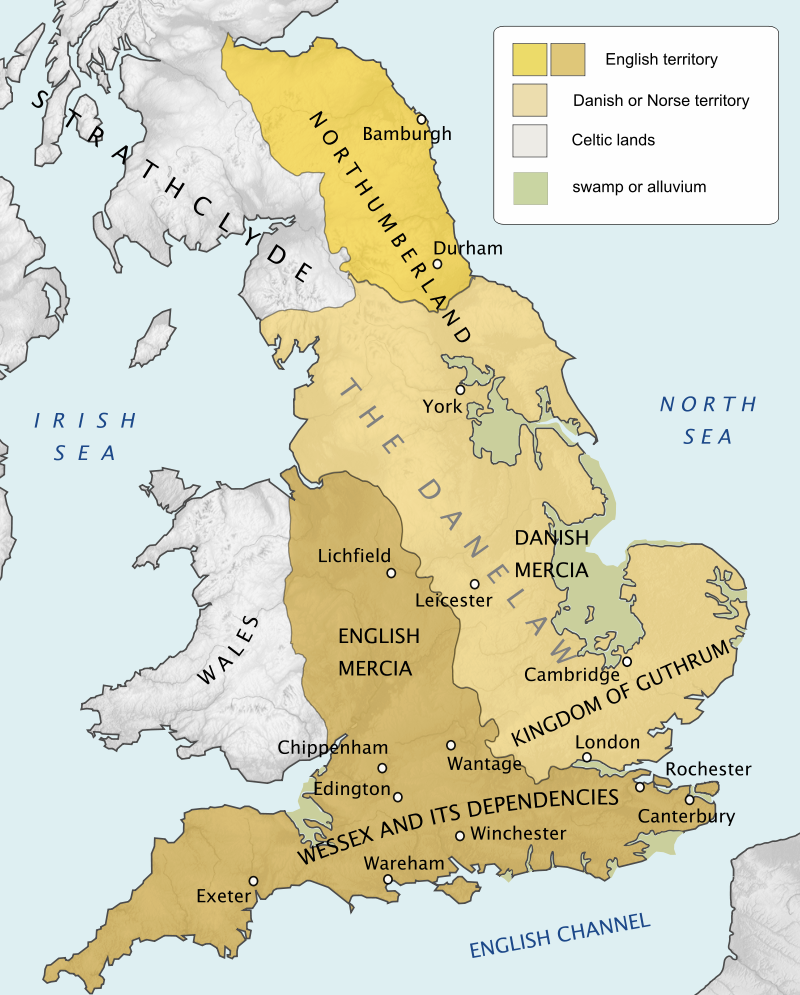
Where did this fascinating dialect come from? We offer the 9-minute film clip below, tracing the origins of the language in the linguistic wrestling between the Anglo-Saxons and the Viking settlers under the ancient Danelaw, a term which designated the lands under the jurisdiction of the Norse invaders. According to linguists, the compromises that resulted created the English we speak today. Yorkshire villages like Oxgodby were the go-to places for language oh, say about a thousand years ago.

Can’t get enough? Below the video clip we offer two soundtracks of the Yorkshire accent from the British Library – in the first, a man describes his Yorkshire childhood in the 1920s, describing a world very much like Oxgodby.

1) Welwick, Yorkshire: Miss Dibnah explains how to make white bread, brown bread and spice bread. Read a transcript of this recording on the British Library’s ‘Sounds Familiar’ website. Link here.

2) Appleton Roebuck, North Yorkshire: Sydney talks about growing up in the 1920s with six siblings in a small, three-bedroomed house in Appleton Roebuck. Link here.

What the reviews said, then and now…

“This was the book nobody rejected, because they did not get the chance,” wrote biographer Byron Rogers of J.L. Carr’s A Month in the Country. That’s not quite true. There were a few reviews of Carr’s book when it was first published, even before it was short-listed for the Booker Prize and received the Guardian Prize for fiction.

Still, the tone for the early reviews before the awards were announced, and the tone now, decades later, is markedly different. See if you agree.

Reviews in 1980:

“There is a strong temptation to call this an idyll, and the temptation need not be resisted, for so it is, in the true sense of the word. But this should not suggest any sort of cloudly poeticism. The writing is energetically colloquial, well-salted with specific detail. Totally unsentimental, but although so clearly observed, it is all seen from a distance. Half a lifetime has passed since 1920, and the brief episode is preserved undimmed and unaltered, needing no other pathos than that of the past. Slight but beautifully done, this book has a quality of its own that will not be easily forgotten.”

Graham Hough, London Review of Books

“It is short; it is odd; it is memorable; it is admirable.”

Marghanita Laski, Country Life

“One of the joys of August, when few novels are normally published, is to catch up with anything which has fallen through the net. J.L. Carr’s new novel is something which nobody should miss whose roots really belong to the English countryside. Mr. Carr’s is a beautiful tale, and, at any rate so far as this reviewer is concerned, a profoundly affecting one.”

Auberon Waugh, London Evening

Reviews since 2000:

Slim as it is, this is a tender and elegant novel that seemingly effortlessly weaves several strands together. Carr has a knack for bringing certain scenes into sudden, sharp focus, rather as waves lift forgotten things to the surface. He writes with particular precision and admiration about the joys of skilled men going about their business. He also subtly evokes lost rural customs and ways of living that, even at the time, had begun to fade from view: cart rides and seed cake and honey-thick accents that had not yet been filed down by mass communication.

The sense of things lost to time is pronounced but not overplayed and there’s a gently elegiac quality to the developing picture of a warm and hazy English countryside summer. This pleasant vision is countered by his rawer and more acute account of the deep mark left on a man when a chance of happiness is glimpsed and missed and left to settle in the memory.

Natasha Tripney, The Guardian, 2010

Happiness is a rare subject. Pain, disillusionment, and misfortune are well documented. Great novels turn on betrayals and confrontations: adulteries and wars; tragic misunderstandings and sudden upheavals of the heart. Plot is driven by conflict (or so the chorus goes). Revelations propel narratives.

Happiness, on the other hand, is trickier. Happiness is static, rarely dramatic. Instead of sudden twists of action and circumstance, it yields subtleties. Contentment builds slowly and steadily build; joy emerges fully-formed from a beautiful collision of time and place. Wonderful in life but, in a book, usually the conclusion of a drama or foregrounding for a tragedy; rarely the foreground.  …

The happiness depicted in A Month in the Country is wise and wary, aware of its temporality. When he arrives in Oxgodby, Birkin knows very well life is not all ease and intimacy, long summer days with “winter always loitering around the corner.” He has experienced emotional cruelty in his failed marriage. As a soldier, he witnessed death: destruction and unending mud.

But the edges are brighter for it. Birkin’s idyll in the country is brought into relief by what Birkin has gone through in the past and the disappointments that, it is implied, await him. Carr’s great art is to make it clear that joy is inseparable from the pain and oblivion which unmake it. In a world where the most vivid heavens and hells are of our creation, Carr suggests, paradise and purgatory are deeply personal. What we value most in life, then, may also be the most difficult to share. After all, though the tacit love between Birkin and Alice is one of the most beautiful and memorable aspects of the book, it really amounts to little: the layers of affinity and implication that grow in their conversations, a blush flaming Alice’s pale cheeks, her vanishing laughter which sounds, “like…well, like a bell.”

Ingrid Norton, Open Letters Monthly

“It was a sort of stage-magic”: the Yorkshire countryside

“Day after day, mist rose from the meadow as the sky lightened and hedges, barns and woods took shape until, at last, the long curving back of the hills lifted away from the Plain. It was a sort of stage-magic – ‘Now you don’t see; indeed, there’s nothing to see. Now look!’ Day after day it was like that and each morning I leaned on the yard gate dragging at my first fag and (I’d like to think) marveling at this splendid backcloth.”

The verdant Yorkshire countryside, with its dales and moors and rivers, will be familiar to readers of the Brontës and Ted Hughes. But, as the saying goes, “Seeing is believing.” We thought you’d enjoy the short video below.

Another Look – revived for a fourth season!

Our new director, Robert Harrison, host of Entitled Opinions radio show. (Photo: L.A. Cicero)

You asked for it. And we made it happen. The Another Look book club will continue this fall under the directorship of Robert Pogue Harrison, a regular contributor to the New York Review of Books, host for the popular “Entitled Opinions” radio show, and, of course, the Rosina Pierotti Professor in Italian Literature at Stanford. His most recent book, Juvanescence, was discussed on KQED’s Forum here.

Robert chaired our event on October 14, 2014, featuring Italo Calvino‘s Cosmicomics. And some of you may have recognized him in the audience for our crowded spring event on Albert Camus’s The Stranger.

With Another Look founder Tobias Wolffs retirement, Another Look will no longer be hosted by the English/Creative Writing Department. Continuing Studies will assume the management of the program. We are still working out the changes that will occur under the Continuing Studies banner.

Stay tuned for the formal announcement that will launch the fourth season of Another Look in the next few weeks.

So long see you tomorrow, Toby! An evening of Camus, crowds, and a fond farewells

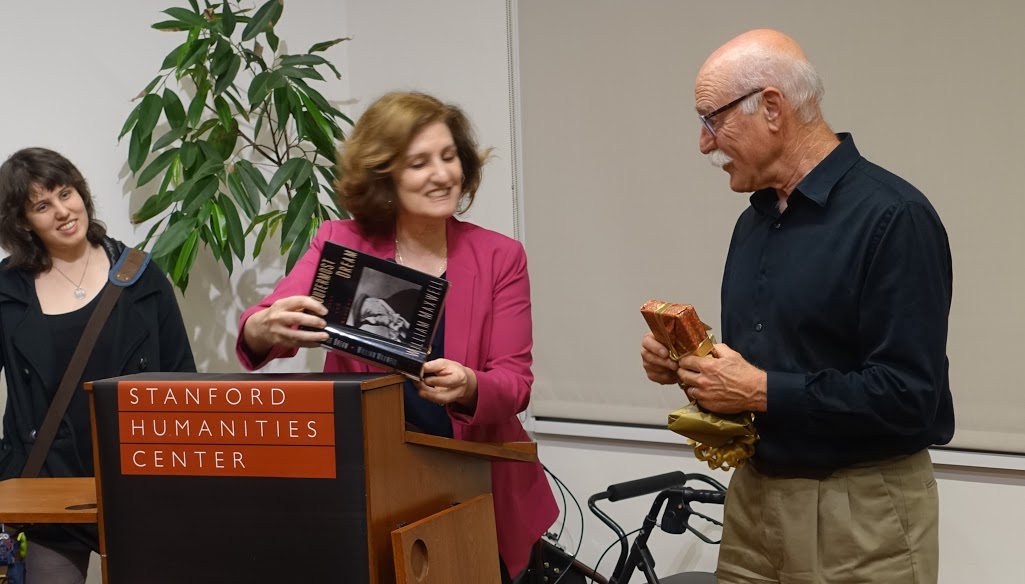
I present some surprises to Toby. Another Look’s graphic designer Zoë Patrick at left. (Photo: David Schwartz)

Stanford’s Another Look book club was born of one man’s love for a short novel – that is, acclaimed author Tobias Wolff‘s love of William Maxwell‘s So Long See You Tomorrow, which became the first book discussed in the three-year series. He wanted to share the book not just with colleagues, but the the world. He called Another Look “a gift to the community.” (We’ve written about it here and here and here and a zillion other places).

So it was fitting that we concluded the era Toby’s directorship with a Maxwell tribute. Why “see you tomorrow”? Because he’s not going far. He’s simply beginning his well-earned retirement. He’ll be around. Meanwhile, the future of the highly successful program he founded is uncertain. We’ll see what happens. Cross your fingers. Burn incense. Whatever works.

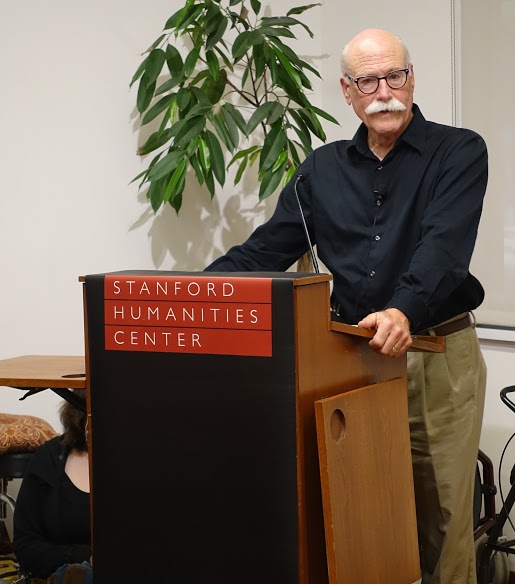
Toby begins – a little amazed at the turn-out. (Photo: D. Schwartz)

The Monday discussion of Albert Camus‘ The Stranger was a knockout event – the turn-out beyond anything we had anticipated. It was way beyond standing room only. The room was impassable, with a mob in the doorway, and another outside the sliding doors to the patio, opened so a smaller crowd could listen in. People sat on the floor in the aisles. There was no place in the room that didn’t have people in it. (I squatted behind the podium and couldn’t see anyone on the panel – you could say I had audio, but not visual, reception.) It was, in short, a love-bomb.

The photos above and below don’t quite capture the size of the crowd photographer David Schwartz, who happened to be in the audience, didn’t have much choice about what he could capture at all. The fans who were lucky enough to have seats were so jam-packed that he couldn’t move.

David couldn’t photograph all three panelists together – so we augment his photos with one of Marie-Pierre Ulloaa scholar of French intellectual life in 20th-century Algeria, taken by Remmelt Pit.

No surprise that the discussion was lively and wide-ranging. Intellectual and cultural historian Caroline Winterer, director of the Stanford Humanities Center, and Toby are old friends, as their spirited exchanges show in the photos. The audience was bubbling with questions – more than the panelists could possibly answer. Many of them focused on the four extra shots fired by Meursault into the Arab – in Matthew Ward‘s esteemed “American” translation (read about him here) is rendered “And it was like knocking four quick times on the door of unhappiness.”

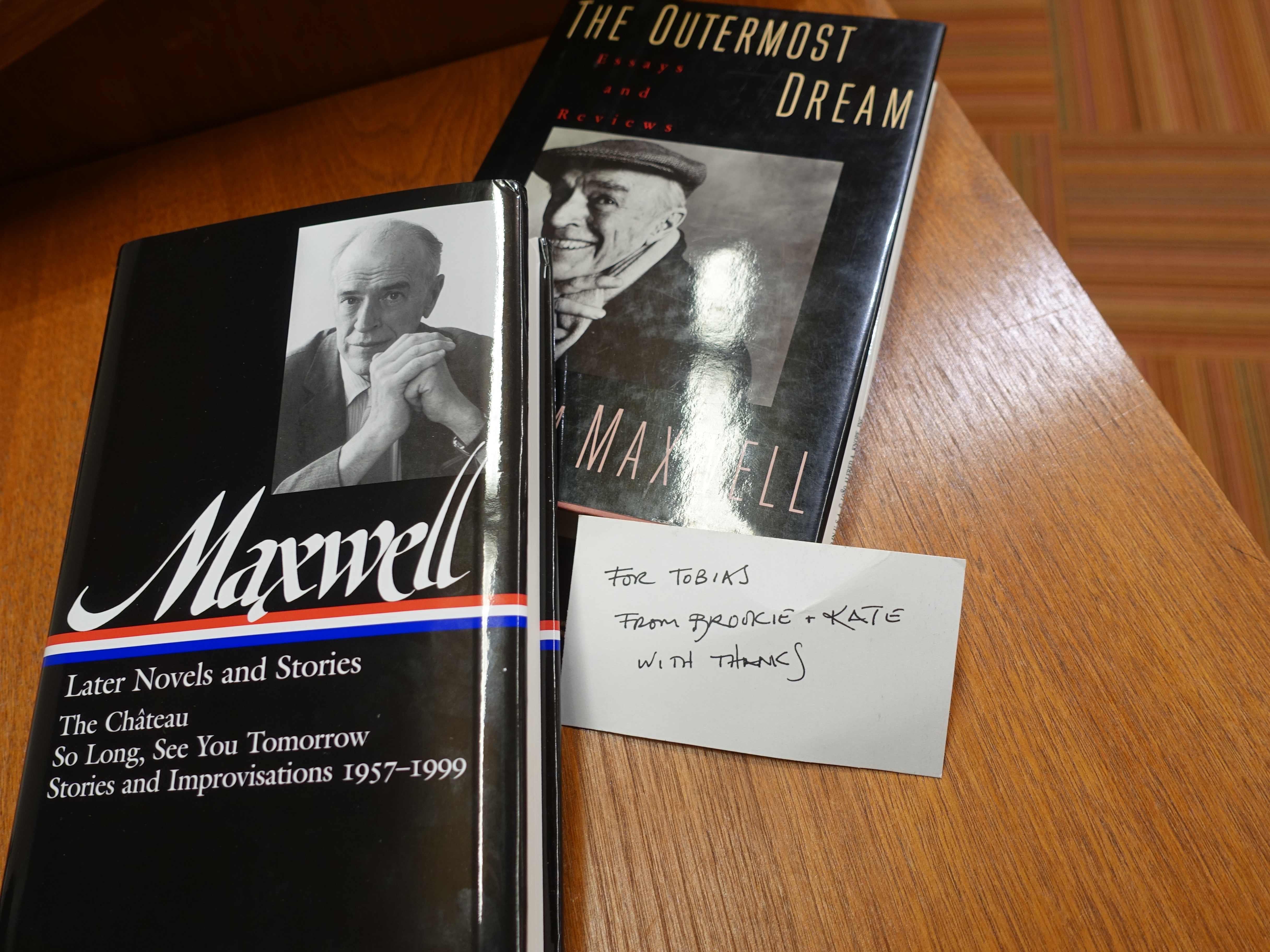
All in all, it was a wonderful send-off for Toby’s retirement – we presented him with a signed first edition of the late William Maxwell’s The Outermost Dream, a collection of his essays from The New Yorker – fitting, because Toby himself is a regular contributor to the magazine.

But the bigger surprise of the evening was the edition of Maxwell’s later novels from Brookie and Kate Maxwell, the author’s daughters, who have appreciated Toby’s attention to their father’s legacy, and his efforts for Another Look more generally. Brookie, also a photographer, included a photograph of her father that she had taken – the photograph with the kitten; you can see it here.

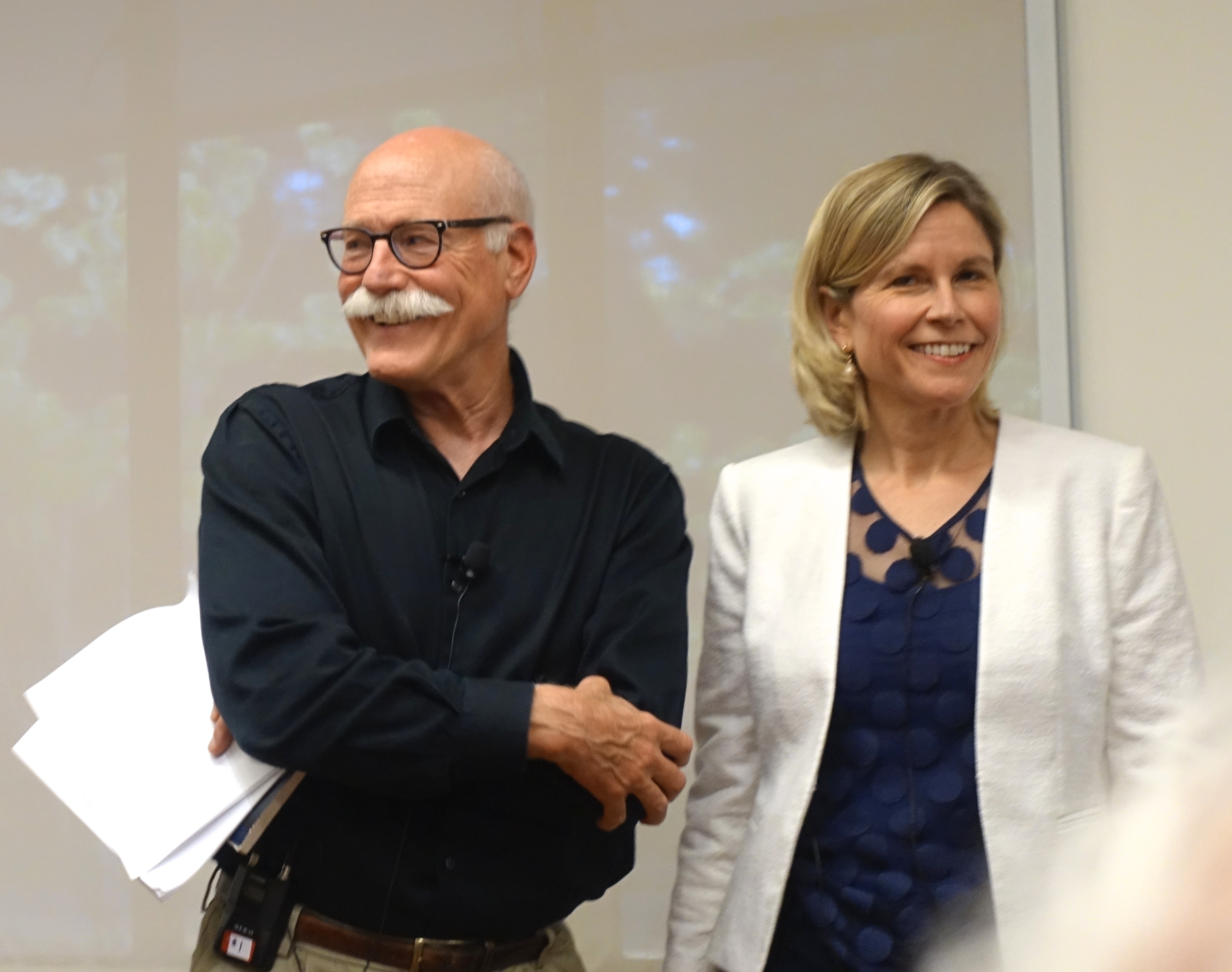
Teamwork: Toby and Caroline. (Photo: David Schwartz)

A spirited exchange between Toby and Caroline (Photo: David Schwartz)

Toby makes a face; Marie-Pierre giggles. (Photo: Remmelt Pit)