
 Truman Chen clearly has a passion for Albert Camus. As a freshman, he used Sophia Coppola’s film Lost in Translation as a vehicle to explain Camus’ concept of the absurd and absurd freedom, from The Myth of Sisyphus and The Fall.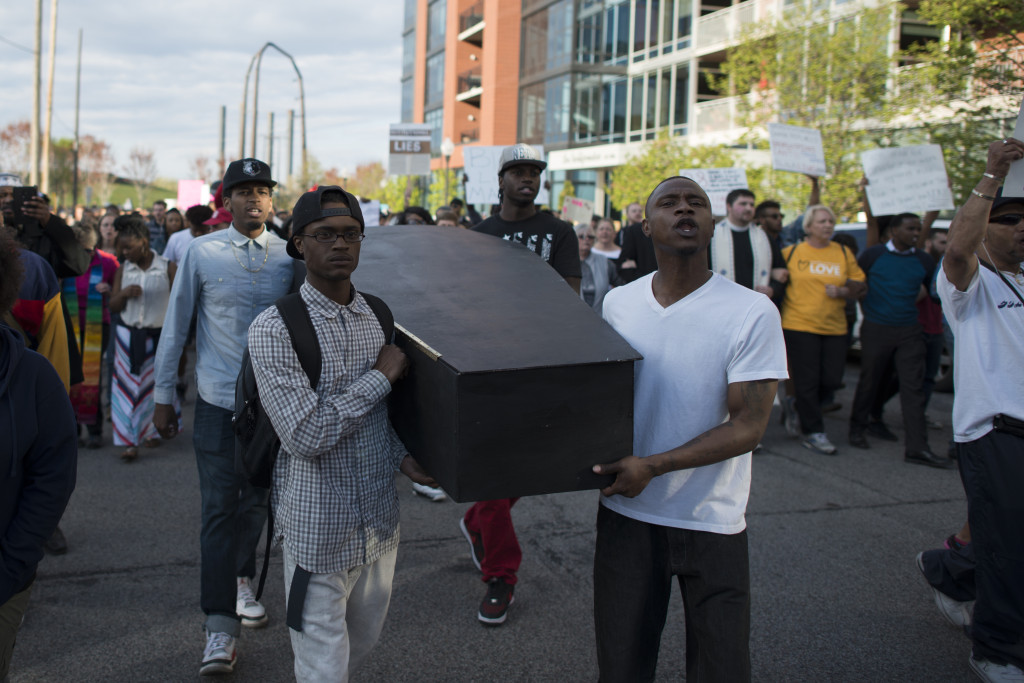
Peaceful protesters in Baltimore (Photo: Creative Commons)
… It is far from clear that to condemn violent resistance is to endorse the oppressor. This is the very problem that alienated Albert Camus from both the French and the Algerians during the Algerian War of Independence. Camus, an Algerian native raised in poverty, of course morally favored an Algerian freedom from colonial oppression, but violence complicated everything. He had always condemned the horrifyingly violent occupation of Algeria by the French, but at the same time he could not endorse the violent means used by the Algerian revolutionaries. He attempted to escape what he understood to be a false dichotomy. Camus expressed his problem poignantly: “People are now planting bombs in the tramways of Algiers. My mother might be on one of those tramways. If that is justice, then I prefer my mother.” Still, the Algerians accused him of supporting the French colonizers, and the Stalinist French intellectuals of his time accused him of being spineless and self-absorbed. But, in the end, like in most wars, there was a truce, a political act pleaded for by Camus since the beginning. …
Thompson is correct that there are those who act violently because they “hold life sacred,” but he has forgotten that there are also those who hold the lives of others too sacred to act violently. In The Rebel, Camus wrote that the act of rebellion is a simultaneous denial and affirmation: a “no” against the condition the rebel finds himself in, and a “yes” for the human dignity he and all human beings deserve. A limit is drawn to protect that which is worthwhile in all humans. The rebel knows what is and what ought to be but is careful in his actions to prevent his “no” from violating the “yes” of others through violence. If he were to act violently against another, his own “yes” predicated upon a universal human dignity would be logically undermined, and if “men cannot refer to a common value, recognized by all as existing in each one, then man is incomprehensible to man.” This comprehensibility is essential for the thinking of political discourse, the only means we have to correct the oppressive power structures. To preserve this avenue for change, it is imperative we renounce violence in all forms, even in the form of resistance.