
Autobiography often appears in Camus’s novels in hints and allusions: his maternal grandfather’s name was Sintes, a name that appears in The Stranger in the French form Sintès, which his family had eventually adopted; his maternal grandmother’s name was Catherine Marie Cardona, another name that appears in the The Stranger. But there’s one haunting episode in the novel that appears to be taken straight from life: Meursault’s long-dead father had witnessed an execution by guillotine; so had Camus’s own father, who died in France during World War I. From Herbert R. Lottman’s Albert Camus (1979):
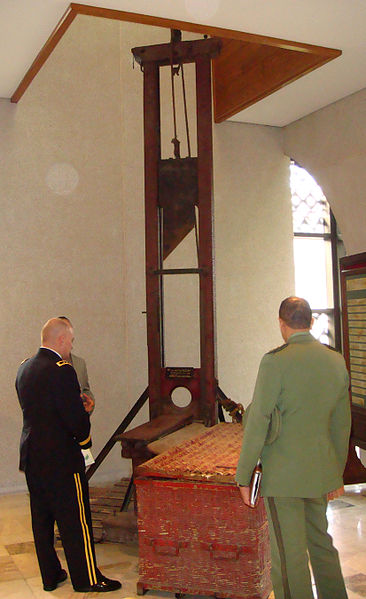
Guillotine used in Algerian War. (US Army Africa/Creative Commons)
It may have been his grandmother Catherine Sintes née Cardona who told the child Albert Camus the only story of substance he would ever hear about his father, and which (perhaps in part because it was the only one) was to count in his life.
Speaking without a fictional screen in his essay “Réflections sur la guillotine,” Camus attributes the telling of the story to his mother. Shortly before World War I, the story went, the murderer of a farm family was sentenced to death by guillotine. Camus’s father, who felt that beheading was too good for the killer of children, decided to attend the execution. He got up in the middle of the night so that he would be sure to reach the execution site in time.
What he saw there he would tell no one. His son only knew that he came home in a hurry, his expression one of distress. He said nothing, threw himself onto the bed, and suddenly began to vomit.
Camus utilized the story some forty years after it occurred to introduce his urgent appeal for abolition of the death penalty. For the ritual act of beheading must have been quite horrible, he observed, to overcome the indignation of the simple, honest man his father was; a punishment which he believed wholly justified had had no other effect than to make the man sick. One could question a punishment which provoked only vomiting in the honest man it was designed to protect.
In L’Etranger, his first published novel, Camus allows his hero Meursault to tell the story; he too had heard it from his mother. It was also the only precise information he had about his own father. But the child Meursault, who would become Meursault the killer of an Arab on the beach, is already too tough to be moved. His father’s act had disgusted him a little when he first heard about it, although now, when he himself is waiting to be executed, he thinks that he understands. What could be more important than capital punishment!
Later in La Peste it will be the father of Tarrou, prosecuting attorney by profession, who rises early to attend executions by guillotine. In the end Tarrou leaves home because of it. All his life the account of his father’s early rising, of his vomiting, will remain with the son. In his dreams he will be the executioner’s victim. It didn’t help that his grandmother would warn him that he’d wind up on the scaffold himself.
As an adult Albert Camus would stand apart from his peers because of his refusal to accept the death penalty, opposing his resistance comrades’ approval of the wartime execution of a Nazi collaborator, opposing postwar executions of convicted collaborators through detesting their actions; his abhorrence for the death penalty was a factor in his break with the Stalinists, and led him to refuse the use of terrorism in a just cause by Algeria’s Moslem nationalists.