TONIGHT: Philip Larkin’s early novel “A Girl in Winter”!

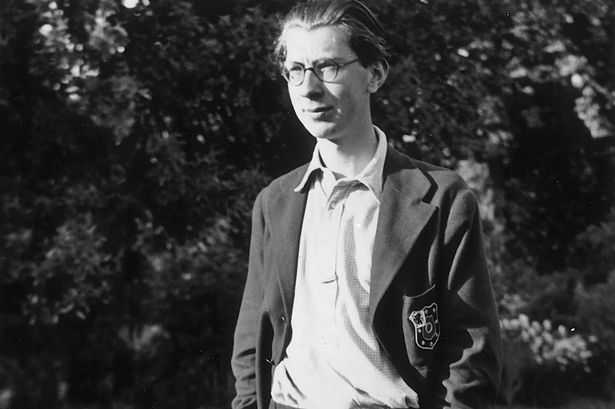
Portrait of the poet as a young man… Philip Larkin

.
Robert Harrison

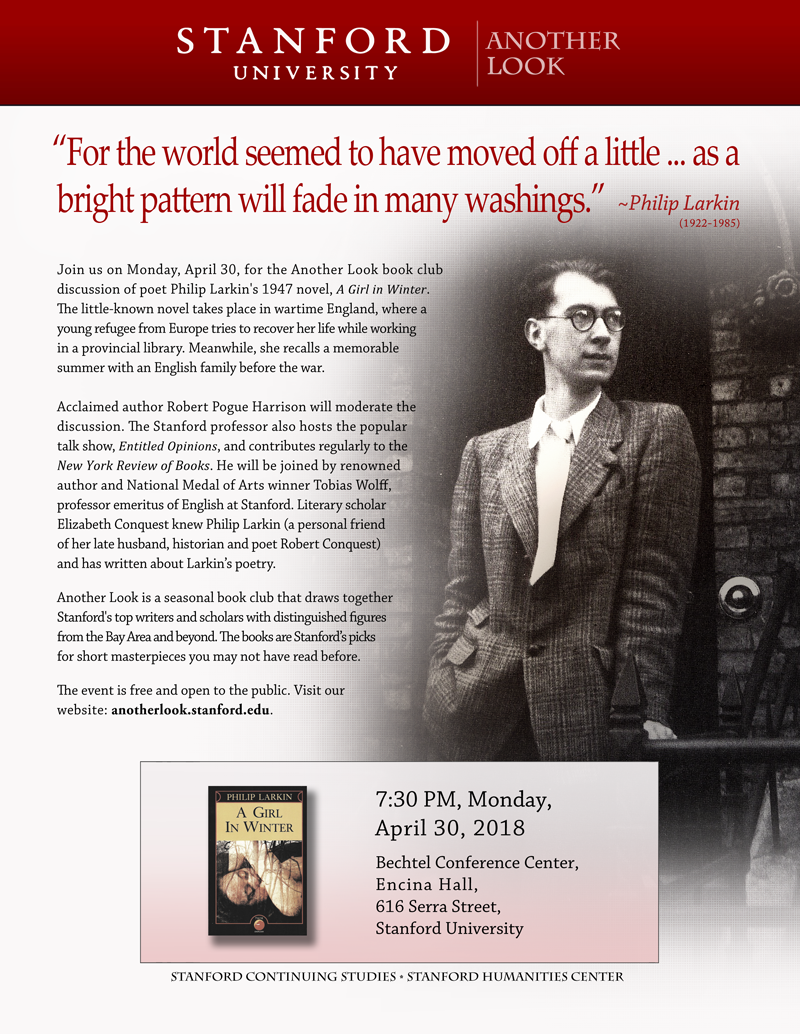
Philip Larkin is one of England’s most eminent postwar poets, but few know of his early forays into fiction. All that changes tonight, Monday, April 30, when Another Look considers Larkin’s little-known 1947 novel that takes place in wartime England, where a young refugee from the Continent attempts to recover her life while working in a provincial library. Please join us! It’s free and open to the public!

Tobias Wolff

When, where, who

The Larkin event will take place at the Bechtel Conference Center at 7:30 p.m. on Monday, April 30. Panelists will include Another Look Director Robert Harrison, who will will moderate the discussion. The Stanford professor and author also hosts the popular talk show, Entitled Opinions. He will be joined by renowned author Tobias Wolff, the founding director of Another Look, and literary scholar Elizabeth Conquest. “Liddie” Conquest knew Philip Larkin—a close friend of her late husband, historian and poet Robert Conquestand has written about Larkin’s poetry.
.

Liddie Conquest

Elizabeth Conquest in the Wall Street Journal

As we wrote in the Book Haven last week, “Liddie” Conquest was featured in an article in the Wall Street Journal. The article is available to subscribers here. The article is excerpted on The Book Haven here.
.
Directions
.
The Bechtel Conference Center hosts all of Another Look’s events – a map is here.The nearby Knight parking structure, underneath the nearby Graduate School of Business, has plenty of room for free parking (see herefor a map). In addition, parking is available on Serra Street and in front of Encina Hall itself.
.
See you there!
.
Frankenstein@Stanford: excellent company and an unforgettable book on a very rainy night!

Another full house for Another Look’s bicentennial celebration of Mary Shelley‘s Frankenstein; or, The Modern Prometheus. And though the night was rainy, the audience was warm, intelligent, and enthusiastic. Although Frankenstein was a special two-hour session with four discussants, we barely scratched the surface of the aesthetic and moral dimensions of the novel. As promised, we focused on the book as a literary work: a flowering of the romantic imagination, as well as a pioneering landmark in science fiction. Though the Another Look director, Robert Pogue Harrison, had some penetrating observations about moral responsibility for invention in a technology age – we are all heirs of Victor Frankenstein, who abdicated responsibility and abandoned the creature he had created.

Dr. Audrey Shafer, a Stanford professor and anesthesiologist on the steering committee for  Frankenstein@200 campus-wide events, made opening remarks, and presented the panelists with Frankenstein mugs, a keepsake for participation in the Stanford program. Robert Harrison moderated the discussion. He was joined by three panelists who have all taught Frankenstein at Stanford: French Prof. Dan Edelstein, Classics Prof. Andrea Nightingale, and former Stanford fellow Inga Pierson.

Another Look’s winter event on Frankenstein was part of Stanford’s year-long celebration of the bicentennial of the book’s 1818 publication, when the young author was twenty years old.

Her tale has proved timely, even prophetic, given our current concerns about artificial intelligence, animal-to-human transplants, and stem cells. Frankenstein explores role of conscience in creation, and asks: What does it mean to be human? Is it wise to play God? And don’t we all fear that our creative triumphs will turn against us, destroying us and those we love.

According to critic Harold Bloom, “The greatest paradox and most astonishing achievement of Mary Shelley’s novel is that the monster is more human than his creator. This nameless being, as much a modern Adam as his creator is a modern Prometheus, is more lovable than his creator and more hateful, more to be pitied and more to be feared, and above all able to give the attentive reader that shock of added consciousness in which aesthetic recognition compels a heightened realization of the self.”

Photos for the event were taken by our faithful Another Look fan David Schwartz.

The much-awaited podcast is here. Enjoy!

Join us on Wednesday, January 24, for Mary Shelley’s Frankenstein!

“The Creature Gazing into a Pool.” Artist: Lynd Ward, provided by the Estate of Lynd Ward

Two hundred years ago, 20-year-old Mary Shelley published her masterpiece, Frankenstein; or, The Modern Prometheus. It was an immediate popular success. The book would rock the world, and inspire films, theater adaptations, television shows, video games, sequels, and spinoffs. But today’s public conception of the hero may owe more to Boris Karloff’s iconic 1931 film role than to the “the Creature” that Shelley created in her classic, with its complicated and troubling humanity.

Hence, our winter “Another Look” event spotlights Shelley’s Frankenstein. The discussion will take place at 7:30 p.m. on Wednesday, January 24, at the Bechtel Conference Center. Frankenstein will be a special two-hour event with four panelists. 

Another Look’s winter event on Frankenstein is part of Stanford’s year-long celebration of the bicentennial of the book’s 1818 publication. Shelley’s tale has proved timely, even prophetic, given our current concerns about artificial stem cells, and animal-to-human transplants. Frankenstein explores the role of conscience in creation, and asks: What does it mean to be human? Is it wise to play God? What are the creator’s moral obligations towards his or her creation? While the campus-wide Frankenstein@200 will explore the moral, scientific, sociological, ethical and spiritual dimensions of the book, Another Look will focus on the book as a literary work: a flowering of the romantic imagination, as well as a pioneering landmark in science fiction.

Acclaimed author Robert Pogue Harrison will moderate the discussion. The Stanford professor who is Another Look’s director writes regularly for The New York Review of Books and hosts the popular talk show, Entitled Opinions. He will be joined by three panelists who have all taught Frankenstein at Stanford: French Prof. Dan Edelstein, Classics Prof. Andrea Nightingale, and former Stanford fellow Inga Pierson.

All our events are free and open to the public – and please bring your friends! You can find Frankenstein at the Stanford Bookstore, Kepler’s in Menlo Park, and Bell’s Books in Palo Alto.

A triumph for Sándor Márai’s little-known classic Embers

If you felt a slight tremor in the earth on Wednesday, October 18, the epicenter was at Stanford’s Encina Hall. The Another Look book club took on Sándor Márai‘s Embers – and the whole room rocked!

The event was close to a record-breaker, with about two hundred participants – not bad for an off-the-beaten track Hungarian novel (and only equaled by Zora Neale Hurston‘s Their Eyes Were Watching God).

Sándor Márai’s taut and mesmerizing novel, published in 1942, opens in a secluded Hungarian castle, where an old general awaits a reunion with a friend. It is 1940, and he has not appeared in public for decades. The long-estranged companions talk all night – or rather, the general talks, as the evasive visitor listens to the general discuss love, intimacy, honor, betrayal, and a beautiful, long-dead wife.

The novel is set against the backdrop of the disintegrated Austro-Hungarian empire, and shares the melancholy wisdom of its narrator: “We not only act, talk, think, dream, we also hold our silence about something. All our lives we are silent about who we are, which only we know, and about which we can speak to no one. Yet we know that who we are and what we cannot speak about constitutes the ‘truth.’ We are that about which we hold our silence.”

Acclaimed author Robert Pogue Harrison moderated the discussion. The Stanford professor who is Another Look’s director writes regularly for The New York Review of Books and hosts the popular talk show, Entitled Opinions. He was joined by renowned author and National Medal of Arts winner Tobias Wolff, professor emeritus of English at Stanford, and Jane Shaw, Stanford’s Dean for Religious Life at Stanford.

Toby Wolff, Another Look’s founding director, opened by praising the courage of author Márai to sit down and create a remarkable novel about an all-night conversation – two men meet, but only one of them talks, and they persevere till dawn. The end. A daunting creative challenge that Márai pulls off magnificently.

We were happy to see a lively Hungarian contingent in the audience, too – including the Hungarian Consul General for the Bay Area. And boy, did the Hungarians have a different take on the book – they praised Carol Brown Janeway‘s translation, but said that the richness of their native tongue is AWOL. And while Márai is little known west of the Danube, they assured us his books are everywhere in Budapest.

The podcast is here. And all photos, as always, are by by loyal Another Look aficionado David Schwartz.