Much of the fundamental mathematical work of artificial intelligence models was actually contemporaneous with Dino Buzzati, in the 1940s to 1960s. Although no-one was quite sure yet of the startling effectiveness of such models at scale, when the perceptron (a single layer neural network) was invented in 1958, it was already claimed to be the embryo of a computer that in the future would be “able to walk, talk, see, write, reproduce itself and be conscious of its existence.” [See link below] [1]
Endriade and the scientists in Buzzati’s novel build their artificial intelligence without language. “It doesn’t know any languages. Language is the worst enemy of mental clarity. In his desire to express his thought in words at all costs, man has ended up making such messes.”
The novel mentions that Laura has “a soul,” called “the egg” – her, or its, personality and consciousness emanate from it. But we cannot isolate which parts of even our current non-conscious models – which attention heads, which single locality – contains specific capabilities or attributes or personalities. They are all distributed, and like in our brains, one neuron can be overloaded with many simultaneous uses. I cannot say if the soul is a capability or trait, but I should think that it is much more complex than what we think of as capabilities and traits in models that we currently have. The ability to write a line in iambic pentameter should not be as complex as having a soul.
Please join us at 7 P.M. (PST) on Thursday, April 17, when Another Look presents Dino Buzzati’s 1960 The Singularity. The hybrid event will take place in Levinthal Hall at the Stanford Humanities Center at 424 Santa Teresa Street on the Stanford campus.
The Singularity, originally published in 1960, probes some of the deeper human questions surrounding artificial intelligence. It was republished last year in a new translation from the Italian by Anne Milano Appel for New York Review Books.
Will Dunn, writing in The New Statesman, called it “a stylish, compelling little mystery” that, although more than six decades old, “predicts … with unsettling accuracy. Its characters are confronted by the presumptuous arrogance of men whose brilliance in engineering disguises how morally and emotionally incapable they are.”
Kevin Brockmeier, writing in Electric Literature, called Buzzati “one of the great literary practitioners of the dark marvelous … one corner iin the triangle of indispensable twentieth-century Italian fantasists, along with Italo Calvino and Tommaso Landolfi.“
Panelists will include Stanford Italian Prof. Robert Pogue Harrison, author, director of Another Look, host of the radio talk show and podcast series Entitled Opinions, and a regular contributor to The New York Review of Books, and Stanford Prof. Tobias Wolff, one of America’s leading writers and the founding director of Another Look, as well as a recipient of the National Medal of Arts.
We have two guest panelists as well:
Stanford Associate Prof. Laura Wittman, is a specialist in modern Italian literature. Some of you will remember her from our 2018 event on William Henry Hudson’sGreen Mansions.
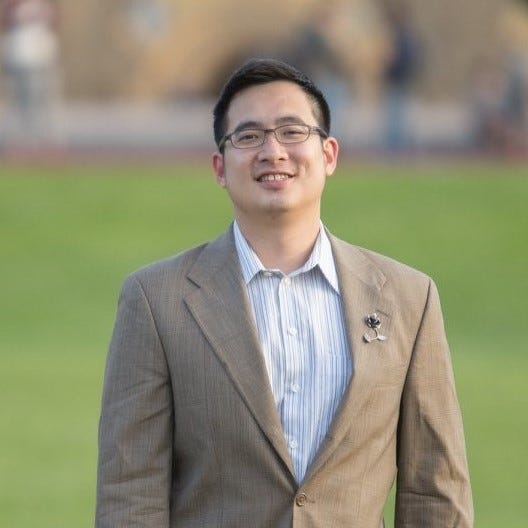
Bryan Cheong received his Bachelor of Science from Stanford University with a degree in applied and computational mathematics before receiving a Masters in Materials Science, also from Stanford. For the past few years he’s been working in the high-tech sector of Silicon Valley.
Stanford will be featuring an “Another Look” discussion of Dino Buzzati’s 1960 The Singularity on Thursday, April 17, in Levinthal Hall at the Stanford Humanities Center at 424 Santa Teresa Street on the Stanford campus.Register for the event, whether on zoom or in person, here.
Meanwhile, in preparation for the event,Another Look director, Stanford Prof. Robert Pogue Harrison, interviewed Edwin Frank, director of New York Review Books and the founder of the NYRB series.Enjoy!
Robert Pogue Harrison: Congratulations on rescuing Buzzati’s remarkable novel from oblivion. Almost none of my literary friends in Italy had heard of it before I mentioned that a new English translation has recently been published by NYRB. Now it seems that Amazon Italy has made it available on demand, no doubt because of the attention the book is receiving in the USA. May I ask how this book first came to your attention?
Edwin Frank: I don’t exactly recall who alerted me to the existence of the book. It may have come through our readers recommendations page, and I read it in the old translation.
Harrison: In Italian the book is called Il grande ritratto (“The Great Portrait”). The English title has little if anything to do with the original title. Why did you and Anne Milan Appel (an excellent translator) decide to call it “The Singularity”?
Frank: Buzzati’s title makes it clear that the book is, as so many of his books are, more about checkered love than science and consciousness, but the years since have given it an added dimension of significance, and Anne and I hoped to underline this with the title change.
Harrison: The story does not have a happy ending. Do you think that’s because some of the main characters are misguided in their ambitions, or because Dino Buzzati was wary about the direction the new technologies were headed in his time?
Frank: It is a curious instance of a moralizing scientific fable written in the spirit of, say, Diderot, taking on a dimension of prophecy, but it is not alone in that.
Harrison: Around the time Buzzati wrote The Singularity, Martin Heidegger declared: “No prophecy is necessary to recognize that the sciences now establishing themselves will soon be determined and regulated by the new fundamental science that is called cybernetics,” yet he was in fact prophetic when he said that. Do you think Buzzati was equally prophetic when he wrote this astonishing novel?
Frank: The unhappy ending also has a double valence: if it picks up on Wilde’s “Each man kills the one he loves” (and only doubles down on the misdeed if, as in this story, he seeks to reverse that outcome), now we can see it as reflecting a fundamental misapprehension on the part of science about the nature of personhood, one that gives us that much more opportunity to misunderstand one another.
Don’t forget to register for the event, whether on zoom or in person, here.
“My brother’s name was Musa. He had a name. But he’ll remain ‘the Arab’ forever.” Kamel Daoud in 2015 (Photo: Claude Truong-Ngoc, Wikimedia Commons)
In Albert’s Camus’s 1942 The Stranger, a French shipping clerk named Meursault shoots an Arab man on the Mediterranean beach. Algerian author Kamel Daoud retells the story from the point of view of the dead man’s family: “My brother’s name was Musa. He had a name. But he’ll remain ‘the Arab’ forever.”
Another Look discussed The Stranger in 2015 – now we’ll read Daoud’s 2013 retelling of the story, seventy years later. Please join us at 7 P.M. (PST) on Wednesday, November 13, 2024, at the Stanford Humanities Center when Another Look presents Kamel Daoud’s The Meursault Investigation. James Campbell,writing in the Wall Street Journal, calls it “a shrewd critique of a country trapped in history’s time warp.”
Panelists will include Stanford Prof. Robert Pogue Harrison, author, director of Another Look, host of the radio talk show and podcast series Entitled Opinions, and a regular contributor to the New York Review of Books, and Stanford Prof. Tobias Wolff, one of America’s leading writers and the founding director of Another Look, as well as a recipient of the National Medal of Arts.
Stanford lecturer Michaela Hulstyn will round out the panel. Her Unselfing: Global French Literature at the Limits of Consciousness was published with the University of Toronto Press in 2022. Her research interests encompass the global French literary world, including texts by modernist figures in France and Belgium along with writers from Algeria, Rwanda, and Morocco. Like Camus, Daoud was born in Algeria. He says Camus “cured” him in a time and place where ideology has become preeminent. “His priority is not an ideology, but his life, his body,” according to The Financial Times.
“The problem was I liked doubt,” Daoud said.”I was deeply wary of totalitarian explanations. I was born in a collectivist period. The primary value was the group, not the individual. And I am profoundly individualistic.” He now lives under a fatwa.
We are announcing our fall event a little bit early, to allow you time to revisit The Stranger and reacquaint yourself to Camus’s timeless classic. You’ll want to keep it handy.
Jun’ichirō Tanizaki would have been pleased. We didn’t exactly turn off the lights last week, but we did at least turn them down, as the Nobel-nominated Japanese writer would have wished.
The result was a surprisingly intimate evening on on Monday, April 29, as our four panelists took on an unusual event: Another Look discussed Tanizaki‘s 1933 classic In Praise of Shadows at the Stanford Humanities Center’s Levinthal Hall on the Stanford campus. His 73-page essay truly is an overlooked classic, at least in the West.
You couldn’t make it to the event? Here’s another way to attend: the Youtube video of the event is here. And for your listening on the road or as you rest, you can listen to the podcast here. And for photos? Scroll below. (All photos by David Schwartz.)
Panelists included Stanford Prof. Robert Pogue Harrison, author, director of Another Look; Mark Gonnerman, a Stanford PhD in religious studies; Meri Mitsuyoshi, whose appreciation of Japanese aesthetics is informed by study of ritual and intergenerational cultural transmission; and Ethen Wood, the associate director of Stanford’s Sustainable Architecture + Engineering.
As always, this event was sponsored by the Stanford Division of Literatures, Cultures, and Languages and the Continuing Studies Program at Stanford, and the Stanford Humanities Center.
Another Look aficionado Jeanne Verville, who recently visited Japan, wrote us this letter after the Another Look event:
“The long essay was written by one of Japan’s greatest writers at the time Japan was overtaxed with its new extended empire. It was a time when ‘old’ (quiet and sequestered) Japanese aesthetics and ways of life had given way to the rapid change, bright lights, and noise of industrial development and the rise of militarism. Tanizaki looks to the past and reflects on what has been destroyed in Japanese tradition by twentieth century Western influences.
A finalist for the Nobel, but death took him first.
“Having just experienced the architecture of temples, shrines, a ryokan, tea houses, Gassho-Zukuri farmhouses, large rambling gardens, the Ryoan-ji Zen temple garden, government buildings, and modern Tokyo’s Ginza area, bullet trains, the new train station in Kyoto, etc., the essay and discussion deepened my understanding of old Japanese aesthetics, many of which have appealed to me for decades. Think: uncluttered lines, focus on small slices of beauty, the quietness of gardens, tea ceremonies, the people…
“Deepening the learning is always a joy, but the experience of reading the essay and attending the discussion resonated for me in even deeper ways as I search for healthy ways of being in the scream of today’s terrifying changes: climate, political, religious intolerance, overt hatred, immoral wealth distribution, discrimination, and materialism.
“Questions the discussion raised for me:
What am I missing by turning on the lights? What am I not noticing in the shadows? When is the last time I truly lost myself peering into the night sky? What do I hear and feel when sitting alone in the dark by the lake? What mysteries of life have disappeared in the glare of the spotlight? How does shadow create intriguing aesthetics? What comforts do I allow myself that detract from beauty and calm? What would I gain by not reaching too quickly for comfort? What aestetic pleasures am I missing by performing tasks in the light? (e.g., more fully feeling . shapes and textures when folding clothes) What would cooking by candlelight feel like? What would I notice? What insights am I missing by not walking around the block in the dark? What am I missing by spending too much time on blue light-emitting devices? Am I self-inducing cyber sickness? In considering the benefits of shadow, how would experiencing them make me feel more . . . connected to my life? How can I come out of my shadows and enhance, in quiet ways, the lives of others?
This event is sponsored by the Stanford Division of Literatures, Cultures, and Languages and the Continuing Studies Program at Stanford, and the Stanford Humanities Center.
Add your own comments in the comments section at the bottom of this post.
Another Look Director Robert Pogue Harrison kicks off the discussion. Below, left to right, Robert Harrison, Ethen Wood, and Mark Gonnerman in discussion. Meri Mitsuyoshi below. All photos by David Schwartz.
Please join us for a discussion of Jun’ichirō Tanizaki‘s 1933 classic In Praise of Shadows. Another Look will discuss Tanizaki’s 73-page essay at 7 p.m. (PST) on Monday, April 29, at Levinthal Hall in the Stanford Humanities Center at 424 Santa Teresa Street on the Stanford campus. This is a hybrid event, so you can come in person or via zoom, but we encourage you to register either way here or on the link below.
Panelists will include Stanford Prof. Robert Pogue Harrison, author, director of Another Look, host of the radio talk show and podcast series Entitled Opinions, and a regular contributor to the New York Review of Books, and three special guests: Mark Gonnerman, who has a Stanford PhD in religious studies, has been a student of Japanese histories and cultures since he first ventured to Kyoto in the mid-1970s. Meri Mitsuyoshi is a longtime Another Look aficionado whose appreciation of Japanese aesthetics is informed by study of ritual and intergenerational cultural transmission.
Rounding out the panel: Ethen Wood, the associate director of Stanford’s Sustainable Architecture + Engineering. For eleven years, he has taught architectural design studio courses and co-taught courses on Japanese modern architecture. In addition, he has his own architectural design office in San Francisco. He grew up in San Francisco’s Zen Buddhist community in the 80’s and spent part of his childhood in a Zen Buddhist monastery in the mountains of Carmel, without electricity. “This was part of a concerted effort by the temple to stay true to the traditions and historic experiences from Japan,” he said.
“In his delightful essay on Japanese taste Junichiro Tanizaki selects for praise all things delicate and nuanced, everything softened by shadows and the patina of age, anything understated and natural – as for example the patterns of grain in old wood, the sound of rain dripping from eaves and leaves, or washing over the footing of a stone lantern in a garden, and refreshing the moss that grows about it,” writes A.C. Grayling in The Guardian. “Tanizaki’s relish in the world and its ordinary pleasures offers a sharp contrast to the functional, plastic, disposable aesthetic of modern western life.”
This isn’t the first time Another Look discusses an essay – our discussion of Virginia Woolf‘s A Room of One’s Own got worldwide attention. We hope Tanizaki’s consideration of Japanese architecture and aesthetics generates the same enthusiasm. Tanizaki (1886-1965) was nominated several times for a Nobel prize, and was on the final shortlist in the year before his death. Youtube video here discusses his life and his book.
This event is sponsored by the Stanford Division of Literatures, Cultures, and Languages and the Continuing Studies Program at Stanford, and the Stanford Humanities Center.