GOOD NEWS!  GENTLEMEN PREFER BLONDES IS MEDICINAL!

Welsh poet Gwyneth Lewis, a former visiting fellow at the Stanford Humanities Center, was delighted to hear of the “Another Look” choice.  The author of Sunbathing in the Rain: A Cheerful Book About Depression  claimed the book helped bring about better spirits.  Here’s what she wrote:

“Anita Loos’s Gentlemen Prefer Blondes (and its sequel But Gentlemen Marry Brunettes) is a natural antidote to gloom, lassitude and should be part of the long-term treatment of depression. It is a diamond in itself – with properties of intelligence, style and wit of the hardest substance known the man. The novel’s joie de vivre is as far from censoriousness as it’s possible to be, giving us a glimpse of a mind so liberated and unsolemn that it’s certainly therapeutic.”

From page to film: Claire Jarvis on Marilyn Monroe’s famous “dumb blonde”

Jarvis: Blonde, 2013 style

Director Howard Hawks’ 1953 adaptation of Gentlemen Prefer Blondes works its way into any discussion of Loos’s novel.  There are obvious difficulties in translating into a musical, and thereafter into a movie, a book that has a complex narrative style as its major formal property.  Hawks’ film doubles down on the divide between Lorelei Lee and Dorothy Shaw; Marilyn Monroe’s naïve ingénue finds a foil in Jane Russell’s sharp-tongued observer.  Plot points transform into song titles, and, with most of the movie’s action taking place on a trans-Atlantic ship and then in a courtroom, the demimondaine’s Grand Tour that makes up the bulk of Loos’ novel evaporates.   Lorelei and Dorothy don’t even make it to the central of Europe!  There are also some striking differences between the novel’s version of a blonde and the film’s.  Loos’ Lorelei is first and foremost a flapper—she is young, but she’s been shifting for herself for quite some time, first finding her footing in a scandalous Little Rock murder trial.  If Loos’ Lorelei is a Jane of all (demimonde) work, Hawks’ Lorelei is a little more above ground: she’s part of a successful nightclub act, and if her passage across the Atlantic is primarily to egg Gus Esmond on to marriage, it’s also a working holiday.

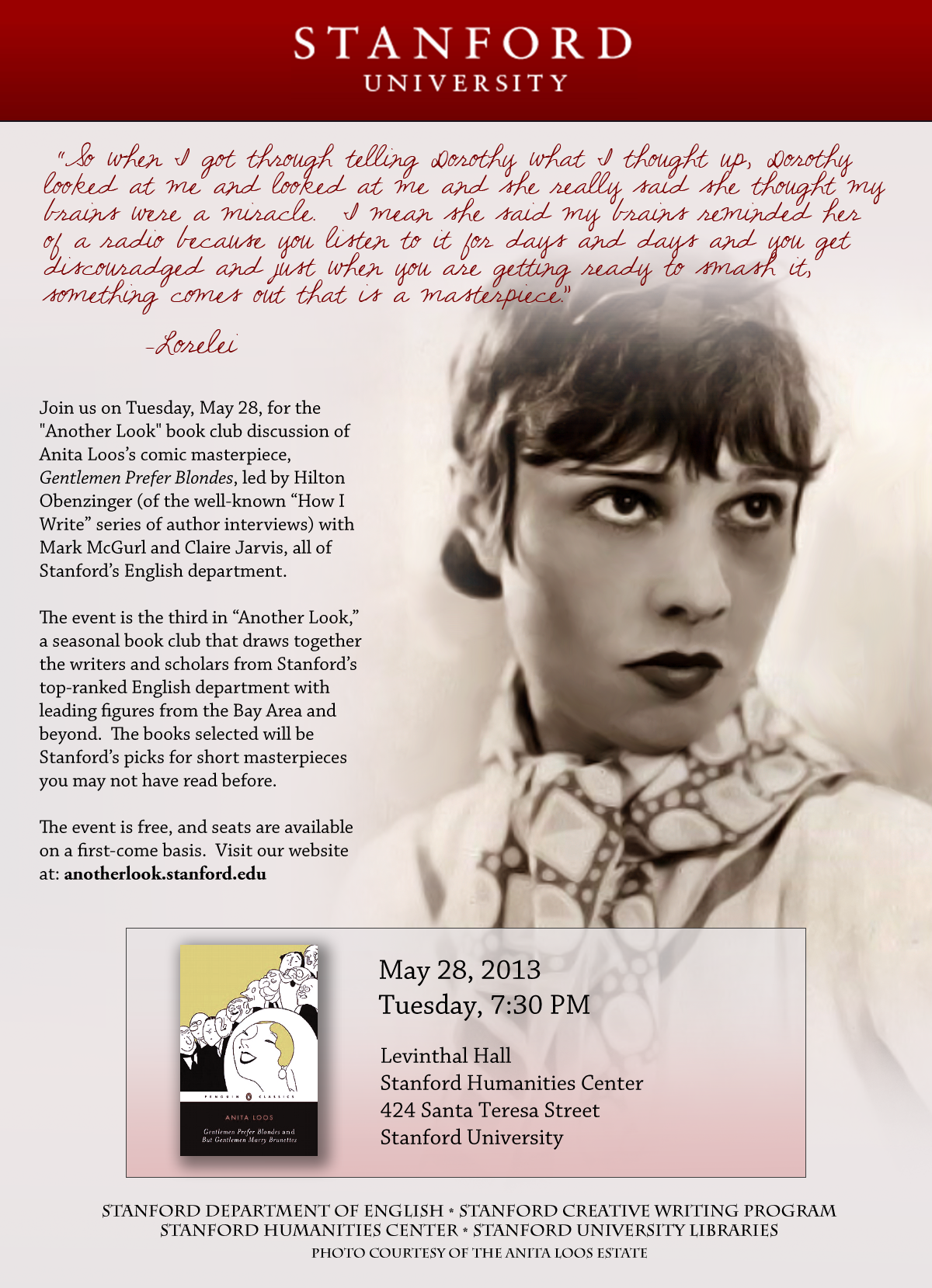
Loos: Not a blonde (Photo: Anita Loos Estate)

To put it a bit more baldly: Loos’ Lorelei is not, as Mark McGurl calls her, a “female moron,” but Hawks’ Lorelei might be.  She is certainly sweeter.   Hawks’ movie works a tension between Dorothy Shaw’s plain-spokenness and Lorelei’s convoluted idiom, and in her final speech, Monroe’s Lorelei makes a case for her character’s operative naiveté. In fact, the intelligence she displays in that speech underscores her character’s virtue: marriage is her aim, and though she gives the appearance of being sexually available, the film’s force rests on her, and Dorothy’s, chastity.  Consider Monroe’s goodbye clinch with Tommy Noonan’s “Gus Esmond,” the character she calls “Daddy,” when she’s about to embark on her voyage: feet firmly planted on the floor, the couple lean into one another, but never fully embrace. This is quite different from Loos’ Lorelei, who, though she remains fully aware of the power of flirtation and the need to present as chaste, is no virgin.

Monroe in “Gentlemen Prefer Blondes”

This is not to say that Loos’s Lorelei is indiscriminate.  In fact, part of her ambivalence about marrying Henry Spofford has to do with her anxiety about spending too much one-on-one time with him.  The plan Lorelei and H. Gilbertson Montrose develop at the novel’s end, to sign Henry on to their motion picture company as a censor (and money-man), gives Lorelei more time to focus on her other interests.  Which, it must be said, come into sharp relief with Montrose’s entrance into the plot.  As Lorelei herself says: “…at last I have met a gentlemen who is not only an artist but who has got brains besides.”  Montrose’s trade in received wisdom (“Hamlet is quite a famous tragedy and as far as novels are concerned he believes that nearly everybody ought to read Dickens”) becomes secondary to the way he treats sex in his film scenarios (“…when Mr. Montrose writes about sex, it is full of sychology, but when everbody else writes about it, it is full of nothing but transparent negligays and ornamental bathtubs.” The “cover” of “sychology” in Montrose’s scenarios works much like Lorelei’s ambient patter.  By presenting a view of the world that captures the presence of sexual life through euphemism, on the one hand, and explicit condemnation on the other, Lorelei’s diary reminds us, again and again, of the centrality of sex to life.  She is, after all, the girl Dr. Froyd couldn’t analyze.

READ MORE, with a video clip from the film, too!

Continue reading

READ ANITA LOOS’S GENTLEMEN PREFER BLONDES WITH US!

More to come shortly.  Meanwhile, please join our mailing list (link at the top of this page) for news and updates. There are no reservations required for this event, but seating is limited and available on a first-come basis.

WE’D LOVE TO HEAR FROM YOU! THE WIFE OF MARTIN GUERRE, CONTINUED…
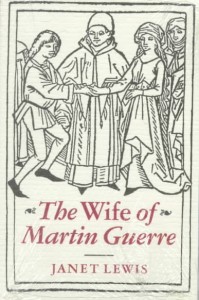
Last night’s discussion of The Wife of Martin Guerre was galvanizing.  Clearly, the standing-room-only event had only started to scratch the surface of Janet Lewis‘s troubling novel in the allotted ninety minutes.  The lively occasion seemed to end with an explosion of “but… but… but…” as we teased out the implications of the 16th-century tale of imposture.

Is Bertrande a hero of conscience – or a victim of inherited conventions? What are we to make of the imposter Arnaud du Tilh?  And, as Stein Visiting Writer Richard Powers noted, isn’t there a moment in every marriage where a husband or wife says to a spouse, “You aren’t the person I married”?

We thought it might be fun to continue the discussion.  Send your comments to clh@stanford.edu, and we’ll post them below.  (Or leave a comment on the “reply” button below, and we’ll move it into this post.)

As always, we’d love to hear from you.

Comments:

I had rather little sympathy for Bertrande while reading the novel. Her dilemma seemed too narrowly religious in a way that didn’t speak to me, she seemed more rigid that righteous, and her chosen mode of resolution seemed far too damaging to those around her.

But during our discussion, I realized that she was fighting for more than the salvation of her soul (in the strictly religious sense): as many of you pointed out, she was fighting for her very selfhood, for the truth of her mind, for affirmation of her sanity.

But one important piece of evidence for this reading was not mentioned last night: the true nature of the imposter’s crime — which was, in fact, a crime against selfhood. No matter how decent a man he turned out to be, he was still guilty of the most fundamental sort of fraud: that of the usurper of somebody else’s selfhood.

This tragic pair – one whose self-knowledge, sanity, and very selfhood were under attack, and the other an unrepentant denier of selfhood, a sort of “self-snatcher” – are stuck in an inevitable conflict that should trouble even the non-religious modern reader. We all have selves – souls – the deepest and most fundamental part of our being. It seems to me that this is precisely what was at stake in this harrowing novel.

– Glen Worthey

I was not too convinced on what happened to the characters in the story. I thought the story was like a tall tale for me. However, I was intrigued by the theme of truth and lies. The author forced her characters to face with truth and lies and lead to their different responses to the challenge. Isn’t it often easier to live with a lie than dealing with truth? Facing the truth can be very painful. Who likes to be in pain? You can find these kind of examples all over the Old Testament. People prefer to look away from the truth. What choice will we make for ourselves: facing the truth with pain and live happily in a lie? How much truth can one handle?

– Sunny Chen

Thank you. It was a terrific evening. Also the “keepsake give away” was very special – thanks for that.

– Wendy Webb

Thank you so much for a sumptuous reading and discussion of The Wife of Martin Guerre. I so appreciate your saving me a seat as I cam coming up from Carmel to enjoy the spirited conversation.  Since my son is a sophomore at Stanford, seeing him during the quarter was an extra bonus!
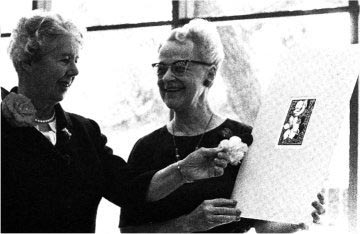
In doing a bit of family history digging, I found out that my grandmother Bernice Taylor FitzGerald and her sister Della Taylor Hoss, were great pals with Janet Lewis. From what my mother remembers, those ladies had many adventures throughout the years: art, book, camping and excursions to Yosemite undertaken as they crisscrossed paths at Stanford.
Attached is a photo of my great aunt Della [left], with Mary Tressider [right], with whom she publishes Trees of Yosemite.  I will contact Della’s son, Peter, and see if he has any photos of Della with Janet Lewis.  No doubt with the all on long skis in Yosemite where he grew up.
Looking forward to the next “Another Look” discussion.  Gentlemen Prefer Blondes!  An inspired choice!

– Bryndie Beach

I found myself comparing Bertrande to one of those wives who have been married happily for years and finds out her husband is a bigamist. I don’t care how happy you’ve been, the idea of ‘forgiving and forgetting’ would be repugnant. She was lied to in the most fundamental way. As Glen [Worthey] said, “he was…guilty of the most fundamental sort of fraud.”

– Elizabeth Waldo

 

“ONE OF THE MOST SIGNIFICANT SHORT NOVELS IN ENGLISH”:  JANET LEWIS AND A BOOK THAT WAS BORN AT STANFORD

In May 1933, a Stanford University Press sales manager was arrested for the murder of his wife at their campus home on Salvatierra Street.

Was it murder or accident? Placid Palo Alto was embroiled in a sensationalized scandal that endured for more than three years. After conviction, appeals and retrials, David Lamson was finally free.

One of the unlikelier outcomes of the notorious case: three distinguished novels by Stanford poet Janet Lewis, focusing on historical trials that had been swayed by circumstantial evidence. The most famous was The Wife of Martin Guerre (1941), which eventually became the subject of an opera, a play, several musicals and a film. Atlantic Monthly called it “one of the most significant short novels in English.”

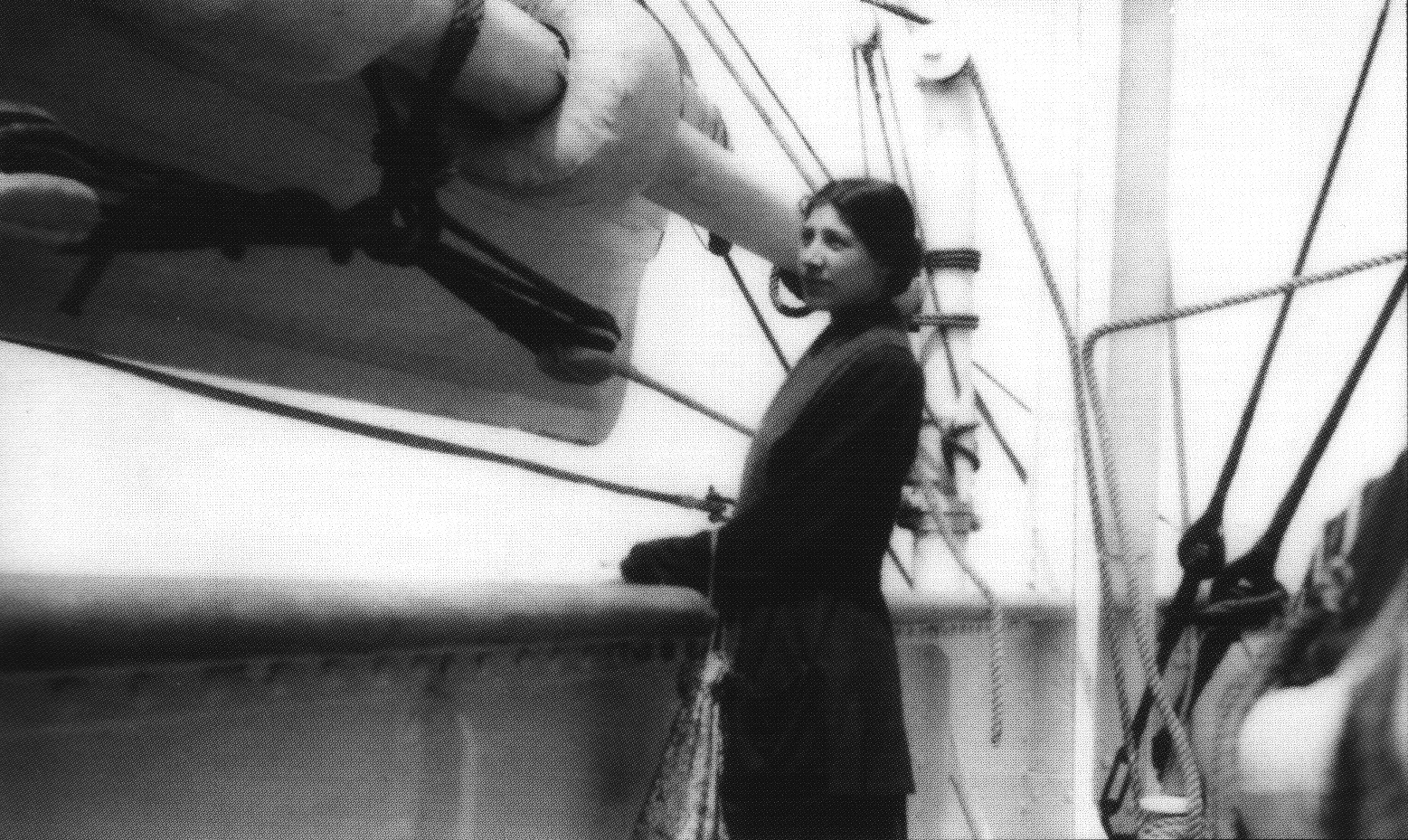
The book will be the focus of the second “Another Look” book club event at 7:30 p.m. Wednesday, Feb. 20, at the Stanford Humanities Center’s Levinthal Room. The event will be moderated by English Professor Kenneth Fields, who was a friend of the late Janet Lewis (1899-1998) and her husband, renowned poet-critic and Stanford professor Yvor Winters (1900-68).  READ MORE…

THE WIFE OF MARTIN GUERRE:  FAMOUS STORY, LITTLE-KNOWN BOOK 

A calculated lie is at the center of Janet Lewis’ The Wife of Martin Guerre, and the lie explodes the life of everyone around it.  The novel a brutal tour de force, defying reader expectations.

“Another Look” seeks out short masterpieces forgotten, neglected or overlooked.  In the case of The Wife of Martin Guerre, we didn’t have to look farther than home.  The 1941 book was born at Stanford, and the author taught in its English Department.  Hailed as one of the top books of the last century, it’s too little-known today. The story has become famous, but the book has not.

The short novel, about a 16th-century case of imposture in southwestern France, has been made into a play, an opera, several musical, and most notably The Return of Martin Guerre, a 1982 movie with Gérard Depardieu in the title role. READ MORE…


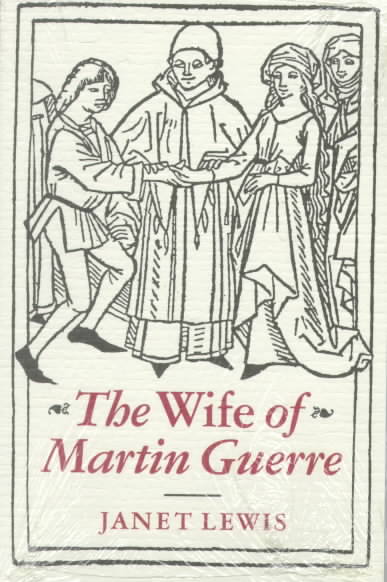
READ JANET LEWIS’S THE WIFE OF MARTIN GUERRE WITH US!

More to come shortly.  Meanwhile, please join our mailing list (link at the top of this page) for news and updates. There are no reservations required for this event, but seating is limited and available on a first-come basis.