

Jarvis: Blonde, 2013 style
Director Howard Hawks’ 1953 adaptation of Gentlemen Prefer Blondes works its way into any discussion of Loos’s novel. There are obvious difficulties in translating into a musical, and thereafter into a movie, a book that has a complex narrative style as its major formal property. Hawks’ film doubles down on the divide between Lorelei Lee and Dorothy Shaw; Marilyn Monroe’s naïve ingénue finds a foil in Jane Russell’s sharp-tongued observer. Plot points transform into song titles, and, with most of the movie’s action taking place on a trans-Atlantic ship and then in a courtroom, the demimondaine’s Grand Tour that makes up the bulk of Loos’ novel evaporates. Lorelei and Dorothy don’t even make it to the central of Europe! There are also some striking differences between the novel’s version of a blonde and the film’s. Loos’ Lorelei is first and foremost a flapper—she is young, but she’s been shifting for herself for quite some time, first finding her footing in a scandalous Little Rock murder trial. If Loos’ Lorelei is a Jane of all (demimonde) work, Hawks’ Lorelei is a little more above ground: she’s part of a successful nightclub act, and if her passage across the Atlantic is primarily to egg Gus Esmond on to marriage, it’s also a working holiday.
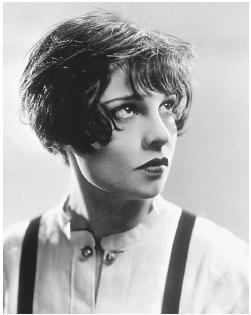
Loos: Not a blonde (Photo: Anita Loos Estate)
To put it a bit more baldly: Loos’ Lorelei is not, as Mark McGurl calls her, a “female moron,” but Hawks’ Lorelei might be. She is certainly sweeter. Hawks’ movie works a tension between Dorothy Shaw’s plain-spokenness and Lorelei’s convoluted idiom, and in her final speech, Monroe’s Lorelei makes a case for her character’s operative naiveté. In fact, the intelligence she displays in that speech underscores her character’s virtue: marriage is her aim, and though she gives the appearance of being sexually available, the film’s force rests on her, and Dorothy’s, chastity. Consider Monroe’s goodbye clinch with Tommy Noonan’s “Gus Esmond,” the character she calls “Daddy,” when she’s about to embark on her voyage: feet firmly planted on the floor, the couple lean into one another, but never fully embrace. This is quite different from Loos’ Lorelei, who, though she remains fully aware of the power of flirtation and the need to present as chaste, is no virgin.
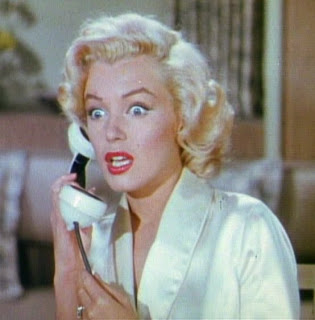
Monroe in “Gentlemen Prefer Blondes”
This is not to say that Loos’s Lorelei is indiscriminate. In fact, part of her ambivalence about marrying Henry Spofford has to do with her anxiety about spending too much one-on-one time with him. The plan Lorelei and H. Gilbertson Montrose develop at the novel’s end, to sign Henry on to their motion picture company as a censor (and money-man), gives Lorelei more time to focus on her other interests. Which, it must be said, come into sharp relief with Montrose’s entrance into the plot. As Lorelei herself says: “…at last I have met a gentlemen who is not only an artist but who has got brains besides.” Montrose’s trade in received wisdom (“Hamlet is quite a famous tragedy and as far as novels are concerned he believes that nearly everybody ought to read Dickens”) becomes secondary to the way he treats sex in his film scenarios (“…when Mr. Montrose writes about sex, it is full of sychology, but when everbody else writes about it, it is full of nothing but transparent negligays and ornamental bathtubs.” The “cover” of “sychology” in Montrose’s scenarios works much like Lorelei’s ambient patter. By presenting a view of the world that captures the presence of sexual life through euphemism, on the one hand, and explicit condemnation on the other, Lorelei’s diary reminds us, again and again, of the centrality of sex to life. She is, after all, the girl Dr. Froyd couldn’t analyze.
READ MORE, with a video clip from the film, too!
More, the “blondes” in these two texts are quite distinct: The flapper blonde is a flapper foremost, and only secondarily a blonde. The most important aspect of her coiffure is that it’s bobbed. The pneumatic blonde of the 1953 film works differently: the bleach, lipstick and corsetry that make her up work as signs of effort, not a retreat from it. And while the dirty little secret of the flapper was that she wore binding undergarments to give her a boyish appearance, the effect was supposed to be one of effortlessness, a response to the wasp-waisted, cotton-candy-haired Gibson girl aesthetic that ran well into the Edwardian period. These are both post-war aesthetics, but the first one depends on an illusion of freedom, while the later one shores up the body against privation.
Finally, obscenity worked differently when the novel first appeared in 1925 than it did at the film’s debut in 1953. In 1925, Ulysses was still banned in the United States, and Lady Chatterley’s Lover was still three years from publication. The movies, though, hadn’t yet come under the Hays code, which ruled over the motion picture industry between 1930 and 1968. Until 1930, film censorship was an ad hoc business, organized state by state by good Samaritans like Loos’s Henry Spofford, who “spends all of his time looking at things that spoil peoples morals [sic].” The result is that Loos’s novel rests on an assumption that some of the things being done within the novel’s frame can’t be represented, even if the acts being covered up can be readily imagined by its readers. By the time Hawks’ film appears, the novel made an escape from euphemism (Go Tell it on the Mountain, Fahrenheit 451, Junkie and The Night of the Hunter were all published in 1953), but the motion picture industry had imposed much stricter guidelines on explicitness. Consider Monroe’s Lorelei as she notices Esmond’s romantic disposition: “He’s got a bulge in his pocket!” Sure, but in Hawks’ film, the bulge is just a diamond.
Lorelei’s misspellings and misprisions aside, for Loos, she is a shrewd character. She understands how powerful sexual desire can be, and she also understands how she can manipulate using sex and its opposite, an assumed, hypocritical chastity. The best example of this is the Mr. Jennings episode, told retrospectively. Lorelei’s first employer after stenography school, the lawyer Mr. Jennings, is “not the kind of gentleman that a young girl is safe with,” (Loos 24). This is a tricky piece of narration, one that floats a number of possibilities. Lorelei hides behind a veil of chastity, but the core complaint about Mr. Jennings must be either that he will not compensate her for her sexual services, or that he will compensate her too openly. The crux in this vignette appears to be that Mr. Jennings has brought Lorelei to his apartment with a girl who “really was famous all over Little Rock for not being nice” (24-5). Lorelei’s self-perception depends on euphemism, on covert property exchange: she can accept diamonds, but not payment—a letter of credit, but not cash.
Below: Film clip of 1953’s Gentlemen Prefer Blondes, with Marilyn Monroe and Jane Russell.