The shadow-lines within The Shadow-Line

Robert Hampson, a Conrad scholar at the University of London, offered these comments on The Shadow-Line for The Cambridge Companion to Joseph Conrad

Conrad close to the time of his own shadow-line. (Beinecke Rare Book and Manuscript Library)

The Shadow-Line begins with the narrator’s younger self going through a period of crisis, which is presented as characteristic of ‘that twilight region between youth and maturity’. He gives up his job as mate and moves into the Officers’ Sailors’ Home, while waiting for a ship to take him back to England. There, he is unexpectedly offered the chance of commanding a ship whose captain has died, and jumps at the opportunity as the ‘ultimate test of my profession’. The story is then constructed in terms of the young captain’s expectations and their frustration by experience. His new role, which he at first sees as the ‘magical solution of all his life-problems’, proves to involve ‘an intricate network of moral imperatives, psychological discoveries, and social responsibilities’ [according to one critic]. Instead of the ‘more intense life’ that he had expected, he finds himself ‘bound hand and foot’; instead of feeling supported by the continuity of captaincy through the ‘succession of men’ who have been his predecessors, he experiences intense ‘moral isolation’. Subsequently, in the various crises the ship faces he feels himself judged and found wanting. In the end, however, through confronting his feelings of guilt and self-doubt, he achieves his professional identity. …

The Shadow-Line recounts a rite of passage into mature identity within the male world of the Merchant Navy. This, however, is not the only border with which the story is concerned. There are also the ‘shadow-lines’ between sanity and madness, the natural and the supernatural, and life and death. Ransome, for example, is not just the epitome of fidelity to duty, but, with his bad heart, is a constant reminder of the imminence of death. Arguably, what the captain learns is what Ransome physically embodies; the performance of duty in the full consciousness of one’s own weakness, the pursuit of ‘a difficult vocation upon an ocean of incertitude’. Liminal states and moments of transition, to which the title The Shadow-Line draws attention, are a recurrent feature of Conrad’s late fiction. Death, in particular, increasingly becomes a focus of attention.
Borys recalls his father, Joseph Conrad: his death, his accent, and his desk

When Joseph Conrad’s first child was born in 1898, the author wrote to Stephen Crane: “A male infant arrived yesterday and made a devil of a row… It’s a ghastly nuisance.” 

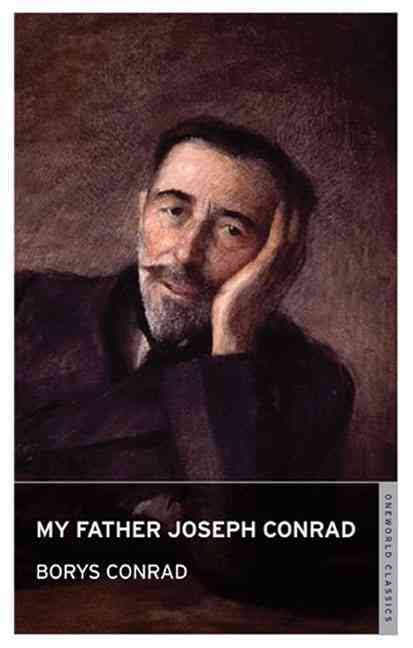
Yet The Shadow-Line is dedicated to Borys, the first of his two sons. Borys was a soldier in the “Great War” who returned from the front, shell-shocked and gassed. Years later, in 1970, he published a memoir, My Father: Joseph Conrad. 

A few excerpts:

When I visited Pent Farm recently I was surprised to see how little it had changed in appearance; and the room in which my Father used to work looked astonishingly familiar. There was an oak table in the corner in the same position as I remembered his desk, and an armchair by the fire exactly as his huge wingchair had been placed. This chair, which remains in my memory as the focal point of the scenery upon the stage of our family life, invariably presented its back to the door so that, when in use, the occupant was invisible to anyone entering he room. Invisible, that is, with the exception of one foot which protruded at the side, owing to his invariable habit of sitting with his knees crossed. I believe we could all assess the mood of the head of the house by a surreptitious glance at that foot. If it was motionless it could be safely assumed that its owner was reading or thinking, and in a reasonably tranquil frame of mind, but any movement of the limb indicated all was not well. In fact, the degree of his displeasure oculd be fairly accurately gauged by the rapidity with which the foot waggled, and really violent movement was a danger signal unwise to ignore.

***

At this point it is necessary to mention that my Father had difficulty in pronouncing certain words in English, and there were those who wrote about him as having a strong foreign accent, but I consider this to be a gross overstatement. Nevertheless, it is true that, when unwell or under emotional strain his mispronunciation became more marked. We in the family were, of course, familiar with most of the words with which he had difficulty but occasionally one would crop up which was not known to all of us. This happened after our visit to the doctor and, for a short time, caused me acute distress.

Continue reading

Werner Herzog Visits Another Look: The Movie!

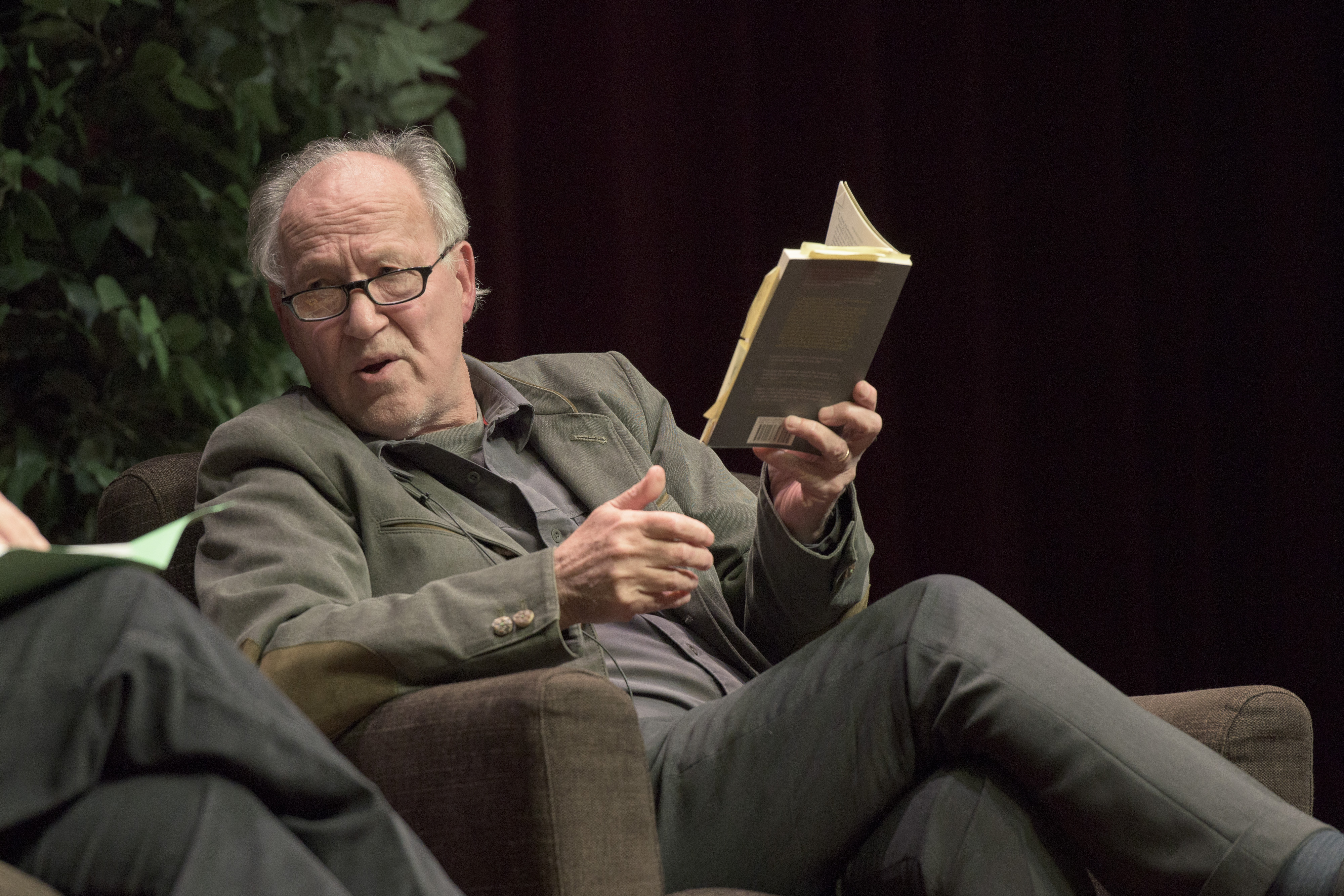
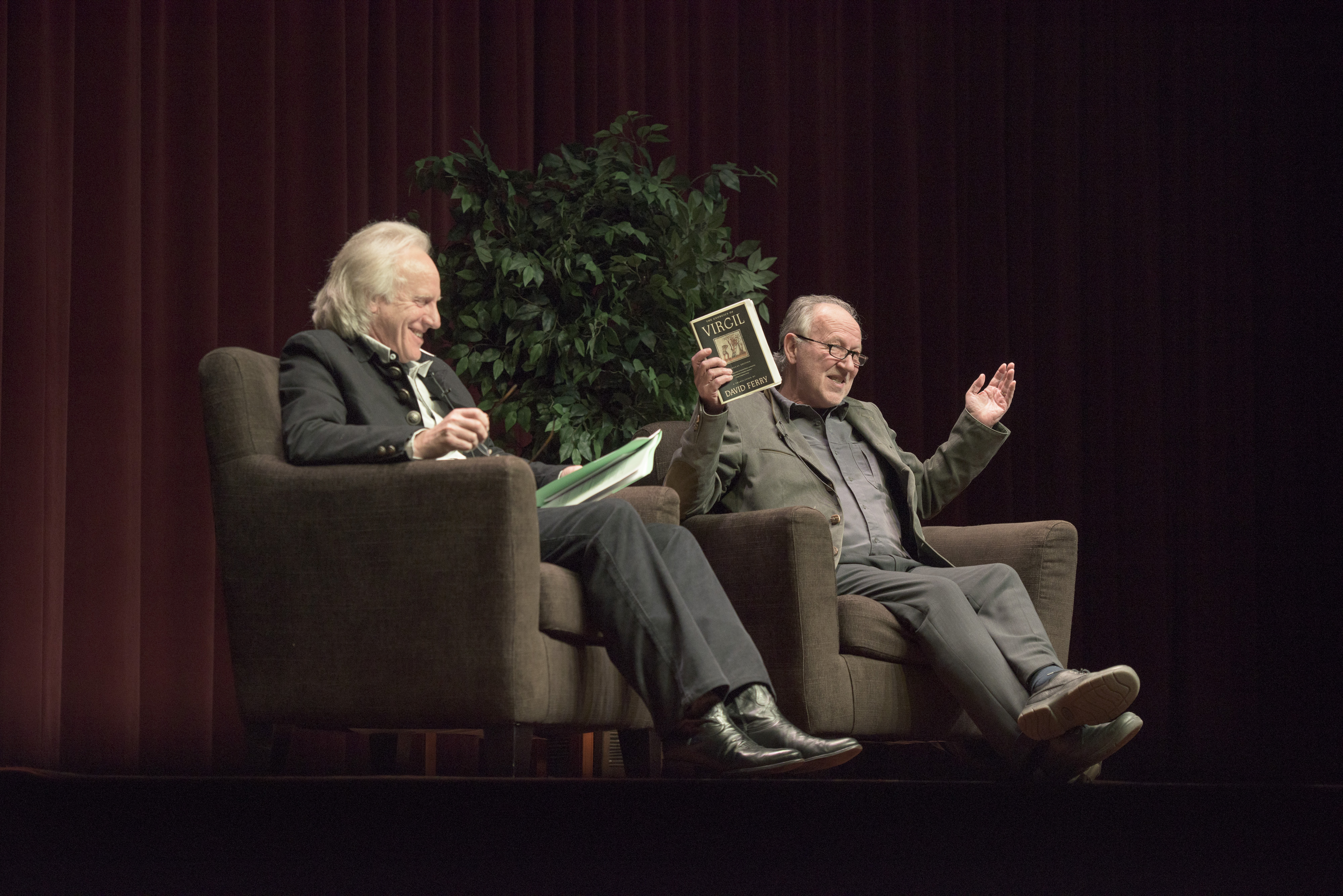
Herzog shares his love of Virgil’s “Georgics” (Photo L.A. Cicero/Stanford News Service)

First the dynamite onstage conversation, now the movie!

Our February 2 event with legendary filmmaker Werner Herzog discussing J.A. Baker‘s The Peregrine – and so much more – is now available on youtube, in a full-length version (here) and a highlights version (here). Or look below.

Herzog quibbles at a point. (Photo: L.A. Cicero)

Another Look’s director, Prof. Robert Harrison, a regular contributor to the New York Review of Books and host for the popular “Entitled Opinions” radio talk show, was the interlocutor for the discussion.

The event was covered by Caille Millner in the San Francisco Chronicle (here). Meanwhile, the highlights version is below, and the full hour-and-a-half discussion below that.

Is The Peregrine one of the greatest books of the 20th century? Werner Herzog is coming to Stanford to say so.

By Cynthia Haven

J.A. Baker wrote The Peregrine at a precarious moment in environmental history: By the 1960s, the falcons had almost vanished entirely from the English countryside, thanks to aggressive use of pesticides. Baker’s response, an ecstatic panegyric to peregrines, stunned critics with its originality, power and beauty.

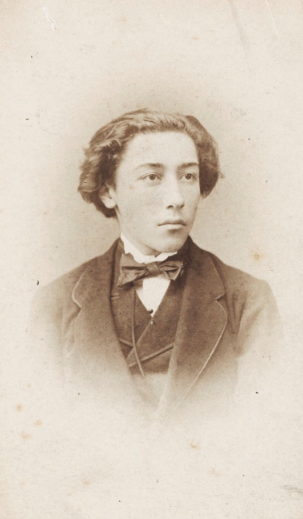
The young J.A. Baker (Photo courtesy Albert Sloman Library, University of Essex)

The little-known 1967 masterpiece will be the subject of an onstage conversation with legendary film director Werner Herzog, who has said that The Peregrine is one of his favorite books.

The Another Look book club event will take place at 7:30 p.m. Tuesday, Feb. 2. The event is free, but registration is required and offered through the Another Look book club’s website; details on the event and the venue are included with registration. The Peregrine is available at Stanford Bookstore and at Kepler’s in Menlo Park.

Herzog’s interlocutor will be Robert Harrison, an acclaimed author and Stanford’s Rosina Pierotti Professor of Italian Literature, who writes regularly for the New York Review of Books and hosts the popular radio talk showEntitled Opinions.

“One of the finest pieces of prose”

Herzog has made edgy films about grizzly bears, prehistoric cave drawings in southern France, Rajput festivals, and more – but he also prides himself on his role as an author and screenwriter. The Peregrine is required reading in Herzog’s Rogue Film School, and he has called it one of the greatest books of the 20th century, praising “an intensity and beauty of prose that is unprecedented, it is one of the finest pieces of prose you can ever see anywhere.”

The Peregrine, which received England’s prestigious Duff Cooper Prize, has no plot and no characters. Instead, Baker distills 10 years of observations into a single autumn-to-spring period, written as a diary. Baker’s passionate, unsparing descriptions of peregrine falcons in the fenlands of Essex convey the urgency of the historical moment:

“Before it is too late, I have tried to … convey the wonder of … a land to me as profuse and glorious as Africa,” he wrote. By the spring of 1961, tens of thousands of birds were found littering the countryside, dead or dying in agony, along with other animals.

 Read the rest here.

A few words from Werner Herzog on The Peregrine

At the Venice Film Festival, 2009 (Photo: Nicolas Genin)

I’m Werner Herzog, I’m a filmmaker normally but I do read. The book I would really recommend is an obscure book published in 1967: “The Peregrine,” by J.A. Baker, who is somebody about whom we know nothing, literally nothing. He wrote in Great Britain when the last peregrines were dying out—now they have bounced back a little bit. He observes peregrines and it’s a most incredible book. It has prose of the caliber that we have not seen since Joseph Conrad. And an ecstasy—a delirious sort of love for what he observes.

The intensity and the ecstasy of observation is something that you have to have as a filmmaker or somebody who loves literature. Whoever really loves literature, whoever really loves movies, should read that book.

In a way, it’s almost like a transubstantiation, like in religion, where the observer becomes almost the object—in this case the falcon—he observes. He writes, for example, about the falcon soaring high up, and then higher and higher until the falcon is only a dot. Then he writes, “and then we swoop down,” as if he had become a falcon himself. And there’s a variety of moments where you can tell that he has completely entered into the existence of a falcon. And this is what I do when I make a film, I step outside of myself into an ekstasis in Greek, to step outside of your own body, a point outside. Baker steps into the fog and in an ecstasy of observing the world it is unprecedented.

It’s a wonderful, wonderful book and it’s on my mandatory reading list of my Rogue Film School. They have to read Roman antiquities, Virgil, Georgics, for example, and old Icelandic poetry, and among others the Warren Commission Report on Kennedy’s assasination, which is a wonderful piece of literature, wonderful crime story. And incredible in its conclusiveness.

What’s it like to have a peregrine for a friend? Ask falconer Hans Peeters.

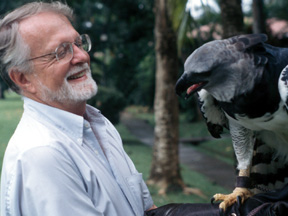
Hans and friend

Hans and friend

Hans Peeters is the author of Mammals of California (2004), Raptors of California (2005), and Owls of California and the West (2007), as well as American Hawking (1970) and a number of scientific papers. He is a painter as well as an ornithologist, and has contributed illustrations for several well-known field guides to North American birds and Birds of South Asia, The Ripley Guide. His paintings have been exhibited in museums worldwide and have been used for postage stamps promoting conservation. 

At 7:30 p.m. on Wednesday, February 10 at CEMEX Auditorium, he is giving a (free) presentation on “Discovering Raptors.” Details and directions here.

We caught up with Hans to ask him a few questions about the raptor that so fascinated J.A. Baker – the peregrine.

Q. Tell me a little about your background with peregrines.

A.  I saw my first captive peregrine at the age of 12 at the house of a falconer in Germany. Since then, the peregrine has always been the pinnacle of falconry for me and is in fact the standard for falcons used in falconry. I flew peregrines almost continually from 1963 until 2003, although I trained other hawks and falcons as well, which of course offered comparisons. I have watched wild peregrines nearly around the world – in India, Africa, Australia, South America, and in the British Isles and Europe.

“Like a very demanding child.”

Q. What’s it like to have a peregrine for a friend?

A. Having a peregrine for a friend is rather like looking after a very demanding child.

Falcons need to be relaxed; otherwise, they damage their plumage, so valuable for flight. Peregrines, unlike other falcons, are by nature calm, but they do expect a decent daily meal. If raised properly, they sit about quietly all day, tethered to a perch, and begin to row their wings as flying time approaches, somewhat as a dog will bark at the door or bring you a leash. Once the hawking season is over – it lasts roughly from September to March, the falcon is usually turned loose in a mews, a special chamber, and allowed to put on some weight, which aids in the growth of new feathers.  Almost all falcons enjoy a bath now and then, and some indulge themselves daily.

Purely from the standpoint of friendship, a peregrine gives one pleasure besides making demands. They are personable enough where they usually recognize their owner and, in the air, will pick him out from among other people, waiting on above him while ignoring others. They also distinguish between the falconer’s dog and other dogs in the field.  As friends, they are reasonably faithful but can be led astray by the urge to migrate, the joys of soaring in warm weather and the hormones of love, as well as by fear of powerful predators – though in the end, they nearly always come back.

You do grow to love them when they perform as desired and when they show some affection towards you in terms of never using their powerful beaks and talons on you.

Q. What do you mean by “waiting on above him”?

A.  Simply put, it is circling overhead at a good “pitch,” or height, to stay in an advantageous position to catch something the falconer kicks up. The falconer waits until the falcon is in position.

Q.  What’s so special about falcons in general, and peregrines, in particular? How are peregrines different from other birds – eagles, for example?

A. Compared to other raptors, such as Red-tailed Hawks, Goshawks, Cooper’s Hawks, and Sharp-shinned Hawks, all of which are trained for falconry, falcons on the whole tend to be calmer and more easily managed – as is the Redtail, an exception among the hawks. All falcons excel at flight and are much more aerial than the other species.

The downside of such flying is that they are relatively short-legged and long-winged, which means in practice, they are less agile on the ground and in cover, where tight turns are important in capturing prey.

Continue reading