
When Joseph Conrad’s first child was born in 1898, the author wrote to Stephen Crane: “A male infant arrived yesterday and made a devil of a row… It’s a ghastly nuisance.”
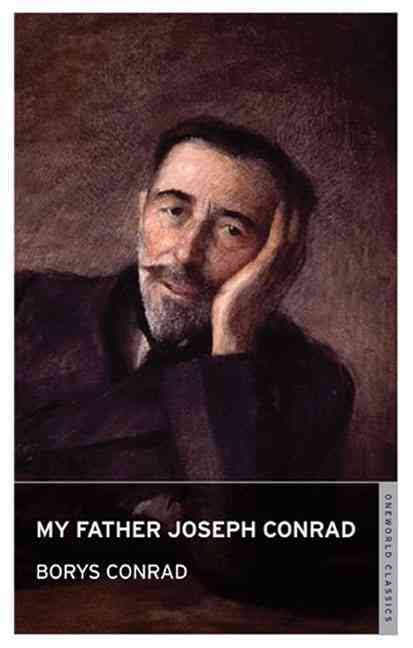
Yet The Shadow-Line is dedicated to Borys, the first of his two sons. Borys was a soldier in the “Great War” who returned from the front, shell-shocked and gassed. Years later, in 1970, he published a memoir, My Father: Joseph Conrad.
A few excerpts:
 When I visited Pent Farm recently I was surprised to see how little it had changed in appearance; and the room in which my Father used to work looked astonishingly familiar. There was an oak table in the corner in the same position as I remembered his desk, and an armchair by the fire exactly as his huge wingchair had been placed. This chair, which remains in my memory as the focal point of the scenery upon the stage of our family life, invariably presented its back to the door so that, when in use, the occupant was invisible to anyone entering he room. Invisible, that is, with the exception of one foot which protruded at the side, owing to his invariable habit of sitting with his knees crossed. I believe we could all assess the mood of the head of the house by a surreptitious glance at that foot. If it was motionless it could be safely assumed that its owner was reading or thinking, and in a reasonably tranquil frame of mind, but any movement of the limb indicated all was not well. In fact, the degree of his displeasure oculd be fairly accurately gauged by the rapidity with which the foot waggled, and really violent movement was a danger signal unwise to ignore.
***
At this point it is necessary to mention that my Father had difficulty in pronouncing certain words in English, and there were those who wrote about him as having a strong foreign accent, but I consider this to be a gross overstatement. Nevertheless, it is true that, when unwell or under emotional strain his mispronunciation became more marked. We in the family were, of course, familiar with most of the words with which he had difficulty but occasionally one would crop up which was not known to all of us. This happened after our visit to the doctor and, for a short time, caused me acute distress.
In due course my Father emerged from the doctor’s house and resumed his seat in the car in silence. We set out on the homeward journey and after a while I ventured to enquire: “What did the doctor say?” The reply hit me like a physical blow: “Oh! Of course you are dying.” I felt unable to make any comment and immediately on arrival home, went in search of my Mother. She naturally noticed my agitation and enquired what was the matter. When I told her what my Father had said to me, she smiled in her usual gentle manner and, putting her arm round my shoulders said: “Don’t worry, dear. He didn’t say, ‘You are dying’, he said ‘iodine’. He always pronounces it ‘uredyne’.” At that time the painting of the affected joint with iodine was the most common treatment prescribed, and his inability to pronounce the word was unknown to me until then.
My Father must also have noticed my agitation, and when Mother took his tea in to him said that he feared I must be “sickening for something.” She assured him that I was perfectly well, but he refused to be convinced, and she was compelled to tell him what had so upset me. I was immediately summoned to his room, informed gruffly that I was a “damned fool”, given an affectionate thump on the back and told to “clear out now”.
***
I should perhaps mention that the costume chosen by my Father for his motoring expeditions was identical with that used when driving our dog-cart, i.e. grey bowler hat, monocle and havelock. The fact that this was a most unsuitable attire when leaping in and out of a moving vehicle seemed to have escaped him.
***
I was able to get a few days’ holiday early in June which was spent at Oswalds, and J.C. passed a lot of his time talking to his grandson and entertaining him by swinging his monocle on its cord for the baby’s entertainment.
Had he lived long enough to see his grandson emerge from babyhood they would have soon become boon companions.
He could communicate with children – even the very young. He was completely sincere with them and knew how to draw them out, so that they talked to him freely, without restraint or self-consciousness.
About mid-July Mrs. C. entered a Canterbury nursing home for yet another operation, and the news regarding J.C.’s health became increasingly unfavourable so, on August 2nd I took my family down to Oswalds for the weekend; arriving there at about seven o’clock in the evening. J.C.’s bedroom was immediately above the front porch and, as soon as he heard my car pull up, he rang his bell and demanded that his grandson be brought to him at once. He lay in his bed propped up by pillows with the inevitable cigarette smouldering between his fingers. Although obviously very ill, he seemed quite calm and relaxed and greeted us cheerfully; then indicated with a gesture that the baby should be put upon the foot of his bed immediately in front of him. After about ten minutes Philip was taken through the communicating door into the next room where his grandmother was lying helpless, having been brought back from the nursing home only a few days before, and J.C. begged me to hurry over my supper and come back to sit with him.
We talked far into the night; about my future with the Daimler Company and in particular, about his grandson. We talked also of the past; of Pent Farm, and of our early motoring adventures, and the close and intimate relationship which had always existed between us now seemed closer than ever before. When I left him he took my hand and said: “Good night, Boy” – then added: “You know I am really ill this time.”
He died early on the following morning. Apparently he had got out of bed and was sitting in the armchair from which Mrs. C. heard him fall. She rang her bell, but when his man-servant reached the room he was already dead.