
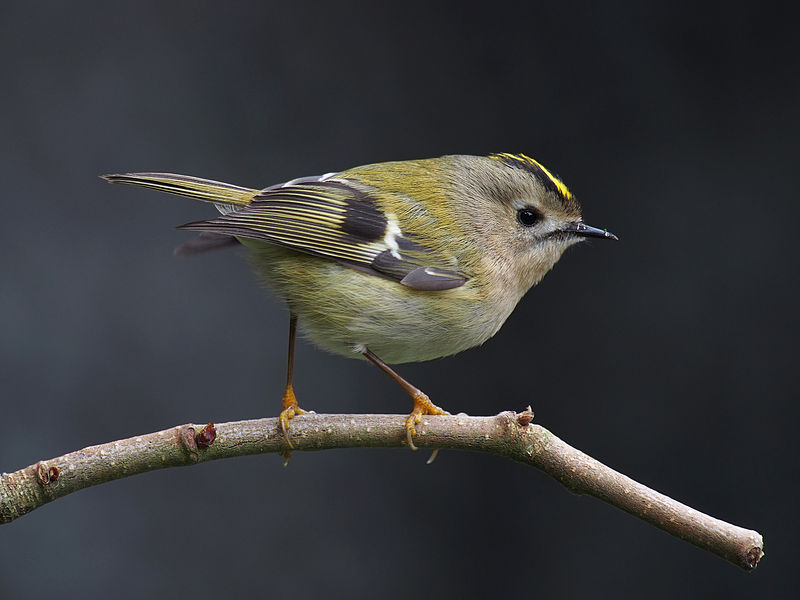
A goldcrest in Lancashire (Photo: Francis C. Franklin)
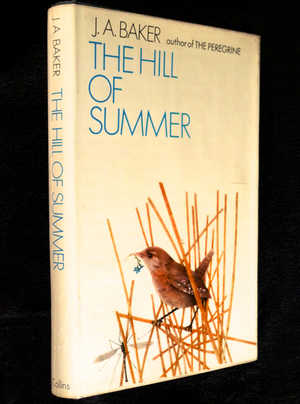
J.A. Baker only wrote one other book after 1967’s The Peregrine. While his first, The Peregrine, charted the Essex landscape from fall to spring, his second, The Hill of Summer, runs from April to September, celebrating the verdant English summer.
Here is an excerpt from The Hill of Summer, published in 1969:
On the far side of the wood, a goldcrest sings among the larches, hidden in the high green light. He hops and flutters quickly along the branches, singing from bare dark twigs. It is a thin song, but vehement, emphatic, ending with a flourish. Occasionally his shrill call-note pierces down, a sound very close to silence. The large wood holds the wind gently persuasively, the high branches sifting it with a sound like the hiss of falling sand. The hot sun, and the big white clouds returning, are far beyond the tree-tops. The light under the trees is green and yellow, like the bending reflections of tree and sunlight in green water. Two swifts, the first of the year, hawk for insects in the upper sky. One rushes down at the other; then they sweep upward together in a rising arc, and fling themselves apart. Their distant screaming trails across the blue. A fox walks past, reddening the shadows. Then all is still; and there are only the nets of sunlight drifting over the dry bracken, and the green bracken growing, and the soft sifting, the endless sifting, of the wind in the feather large leaves.
 A kestrel circles above the trees, gliding and fluttering. It soars higher, twining around the smooth column of the rising air. Above the dark crescents of the swifts it dwindles, feeding upon insects, swerving and half-hovering to catch them in its talons. Swallows rise to mob it; gently it rocks itself up beyond their reach. It floats up till the sky heals over it. It descends, and is visible for a moment, but it rises again to blue. Under and over the blue dust of the air it gleams and vanishes. Then suddenly it turns entirely into light, and is seen no more. I stay in the large wood, drowsy and at peace, while the quiet afternoon subsides into the song-lit April evening.