 In autumn 1951, Albert Camus published his explosive L’homme révolté [Rebel: An Essay on Man in Revolt ]. The book would trigger an equally explosive reaction from his friend and rival, Jean-Paul Sartre. The medium for the message was another French intellectual, Francis Jeanson.
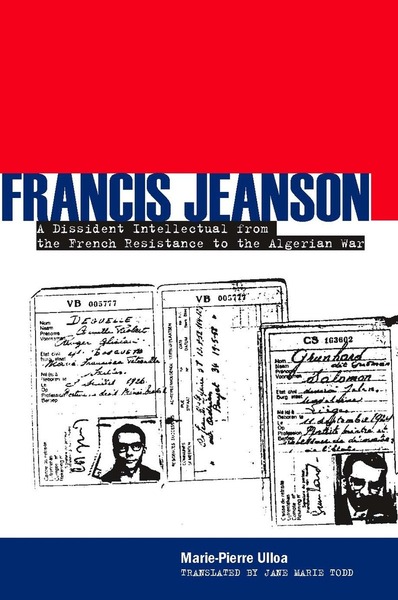
The following excerpts are taken from Marie-Pierre Ulloa’s Francis Jeanson: A Dissident Intellectual from the French Resistance to the Algerian War (Stanford University Press, 2007), a book that “seamlessly blends political, intellectual, and cultural histories in this superb and moving biography of a unique dissident voice,” according to one reviewer. Ulloa will be one of the panelists discussing The Stranger at Another Look’s June 1 event.
If 1943 was Sartre’s year, 1942 was Camus’s. L’Étranger [The Stranger ] and Le mythe de Sisyphus [The Myth of Sisyphus ] were both published that year. Unlike Sartre’s shilly-shallying during the war years, Camus was fully involved in the Résistance in metropolitan France. Beginning in 1944, he contributed to the underground newspaper Combat, becoming its director upon liberation. He too wrote for the theater and had an immediate success with Caligula, with Gérard Philipe in the title role. Media success did not turn Camus away from politics, and as early as 1946, in his Ni victimes ni bourreaux [Neither victims nor tormentors], he denounced Stalinism and its methods. But that was not the last word on the question. In 1951 his indictment Communist barbarism went even further in L’homme révolté. In that study, which caused a scandal at the time, he attempted to elucidate a fundamental mystery: how can man, in the name of a revolutionary ideal, be led to sanction collective murder and thus create totalitarian systems? He meant to submit a certain idea of revolution, both the Soviet notion and that of the crypto-Communist left, to critical examination. That was not the only interest of the book, but contemporaries and posterity would essentially reduce it to that. The essay also had a literary dimension, in that it analyzed the rebel’s artistic creativity. …
 Les Temps Modernes received the book in proofs in September 1951. Previously, Jeanson’s publications in the review had not concealed the misgivings Camus’s work inspired in him. In 1947, in his first two articles for La France Intérieure, “This Scourge of Our Times” and “The Myth of the Absurd,”Jeanson analyzed Camus’s writings in rather tepid terms. He argued in particular that Le mythe de Sisyphe constituted “the negation of all philosophy.” He repeated the offense in Sud-Ouest, the Bordeaux daily that succeeded La Petite Gironde, in an article titled “Respective Positions of Sartre and Camus.” In it he claimed that Camus’s absurdism, which could not be assimilated to Sartre’s existentialism, lay “in the mind’s powerlessness to confer a rational meaning on things. [ . . . ] For man, dignity consists of a voluntary renunciation of any effort whose goal would be to confer a meaning—always illusory—on the world.” He made use of a metaphor to characterize Camus’s argument: “It is [the reasoning] in the name of which the fool Gribouille dives into the water for fear of the rain.” And Jeanson adds: “There are things. There is us. [ . . . ] All of that has no meaning in itself. [ . . . ] But all of that, which constitutes my situation to be precise, is not part of my condition as a consciousness. At that new level, I can accede to a mode of existence different from that of things, I can escape things to return to them later, and to impose on them by that very movement a meaning they will owe to my freedom. [ . . . ] Far from being nonsensical, my life is a perpetual act of meaning.” Camus’s attitude “closes off all hope” and “crystallizes everything that, from Greek skepticism to the most modern preoccupation with abdicating one’s responsibilities, characterizes man’s inclination toward defeatism.” …
The choice Sartre made to assign the critique of L’homme révolté to Jeanson was not innocent. When he asked Jeanson to review the essay, the director of Les Temps Modernes knew that his young collaborator was dubious about Camus’s philosophical abilities: “At the end of six months, it was Sartre who said, ‘It’s going to be even more unpleasant for him if no one says anything at all about his book, it’s better to talk about it. In the end I’ll ask Jeanson to talk about it because [ . . . ] at least it’ll be polite.’[ . . . ] I don’t know what he meant by that, except that I still had a rather bourgeois attitude in his view. That was probably something of a criticism on his part.” Jeanson accepted the challenge and played the game of provocative criticism, ultimately casting off his altogether bourgeois politeness. …
The article, “Albert Camus or the Soul in Revolt,” provoked “the most notorious personalized polemic of the entire postwar period.” It led to the definitive falling-out between Sartre and Camus. That controversy went beyond a simple squabble between authors but constituted one of the defining moments in French intellectual life of that time, setting in motion a political and moral debate.
Jeanson began his attack on Camus by pointing out that his essay was garnering “the approval of the most diverse schools of thought,” from Claude Bourdet’s praise in France-Observateur to Jean Lacroix’s and Émile Henriot’s in Le Monde, and from commendations in Le Parisien Libéré to those of the rightist press generally. The only negative reactions Jeanson mentions are indicated offhandedly in a footnote, and he gives them no credit. According to him, they stemmed from “ill humor (André Breton), for example, or [in the case of] Louis Pauwels, [he] may now be reproaching himself for once harboring the ambition to be Camus.” Regarding the ecumenism of the critics, Jeanson perfidiously declares: “Could that general satisfaction be explainedby a certain inconsistency in his thought, which would make it indefinitely plastic and malleable, able to take on many diverse forms?”
The only merit he found in the essay lay in its literary quality. But once again, a compliment barely advanced was quickly withdrawn. Jeanson found the exposition too literary: “Will we complain that his protest is too lovely?
“Yes, too lovely, too sovereign, too sure of itself, to attune with itself. See how formula tirelessly follows formula, all equally perfect and pure: stripped bare, reduced to the essential, and of which no trace, no smudge of existence survives.” Jeanson condemned Camus’s works one after another, except L’Étranger, which alone found grace in his eyes.