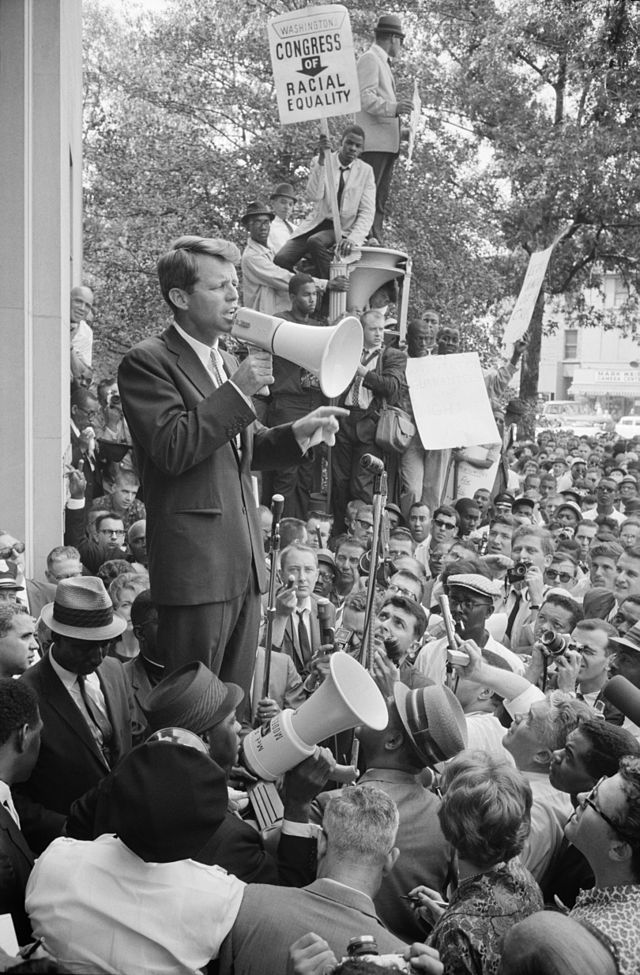
RFK at civil rights rally, June 1963
The encounter was called “intense,” “traumatic,” “excruciating,” three hours of “violent, emotional verbal assaults.” On May 24, 1963, Attorney General Robert Kennedy met with a group of black writers and artists brought together by James Baldwin. Pulitzer prizewinning author Arthur Schlesinger, special assistant to President John Kennedy, gave the fullest account of the event, which came only weeks after the Birmingham, Alabama, agreement for desegregation triggered bombings and riots. Did this difficult confrontation make a difference? Perhaps.
Birmingham convinced Kennedy that the next great battlefield for racial justice lay in the cities. James Baldwin was born in Harlem. His extraordinary New Yorker piece of November 1962, “Letter from a Region in My Mind,” had exposed in searing word the humiliation, despair and rage of Negro Americans. Baldwin and Kennedy had met the year before at the White House dinner for Nobel Prize laureates. They had agreed then that they wanted to talk some more. Now Kennedy invited Baldwin to breakfast at Hickory Hill.
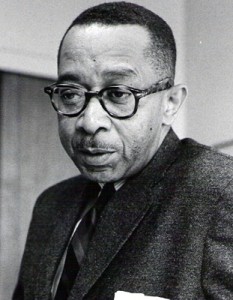
Kenneth Clark
Baldwin was a brilliant, passionate, sensitive, dramatic man imbued with a conviction of utter hopelessness about the black fate in white society. “The Negro’s experience of the white world,” he had written in the New Yorker, “cannot possibly create in him any respect for the standards in which the white world claims to live.” His belief, one felt, was that all white by definition hated all blacks and that white liberals were worst of all because they pretended to deny their innermost feelings. Nonetheless he caught an early plane to Washington. “We had a very nice meeting,” Kennedy said later. “I was really quite impressed by him,” said Baldwin. “… He seemed honest and earnest and truthful.” Burke Marshall, who was present, said, “He and Bob Kennedy had a rather good conversation about the cities.” Baldwin’s plane had been late, however, and Kennedy had to leave for another engagement. He therefore proposed that Baldwin assemble a group with thoughts about the northern ghetto.
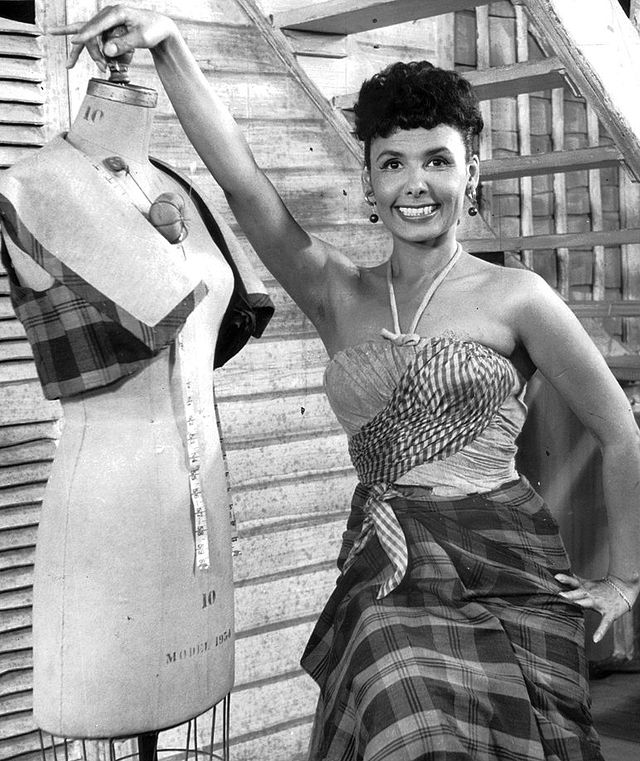
“This boy just put it like it was.”
This led to the meeting in the Kennedy family apartment at 24 Central Park South in New York. Baldwin, acting on short notice, made an effort to enlist experts on the northern city, like Kenneth B. Clark, the social psychologist, Edwin C. Berry of the Chicago Urban League and Clarence B. Jones, an attorney for Martin Luther King. But what Baldwin called “this sociology and economics jazz” was not his métier. He also invited the playwright Lorraine Hansberry and the singers Lena Horne and Harry Belafonte – artists concerned, like Baldwin himself, less with solutions than with the anguish of the problem. Then he brought along Jerome Smith, a young civil rights worker, who began as a Gandhian pacifist, became a Freedom Rider and a CORE field worker and, according to the historians of CORE, “had probably spent more months in jail and been beaten more often than any other CORE member.” He was now in New York for medical treatment.*
Robert Kennedy and Burke Marshall had spent an unpleasant morning urging owners of chain stores to desegregate their lunch counters in the south. The white executives seemed to feel, Kennedy recalled, that “the Devil Incarnate had arrived in New York, and they were asked to meet with him.” They turned out not to be the only people in New York that day who regarded the Attorney General as the devil incarnate.
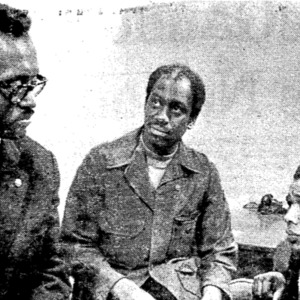
Listen to him, please.
Clark and Berry arrived armed with statistics and proposals. They never had a chance. Jerome Smith, as Baldwin put it later, “set the tone of the meeting because he stammers when he’s upset and he stammered when he talked to Bobby and said that he was nauseated by the necessity of being in that room. I knew what he meant. It was not personal at all. … Bobby took it personally.” This was perhaps understandable. To say, as the Attorney General heard it, that being in the same room with Robert Kennedy made him feel like throwing up seemed a rough way to begin. “Bobby took it personally,” Baldwin continued, “and turned away from him. That was a mistake because he turned toward us. We were the reasonable, responsible, mature representatives of the black community. Lorraine Hansberry said, ‘You’ve got a great many very, very accomplished people in this room, Mr. Attorney General. But the only man who should be listened to is that man over there.’
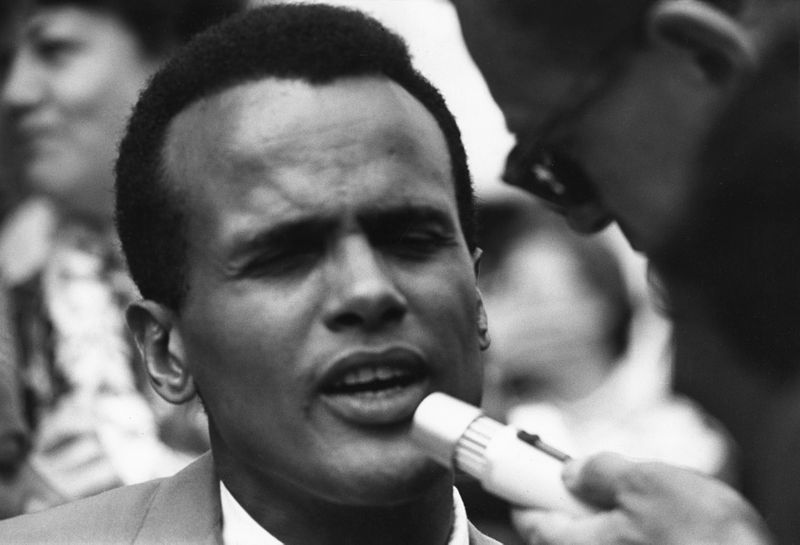
Belafonte – one of “the fortunate Negroes”
Smith talked on with vehement emotion. He told what he had been through in the south. He said he was not sure how much longer he could stay nonviolent. He said, “When I pull the trigger, kiss it good-bye.” Baldwin asked him whether he would fight for his country. He said, “Never! Never! Never!” This shocked Kennedy, for whom patriotism was an absolute. “We were shocked that he was shocked,” said Kenneth Clark. “…Bobby got redder and redder and redder, and in a sense accused Jerome of treason, you know, or something of that sort. Well, that made everybody move in to protect Jerome and confirm his feelings. And it became really an attack!”
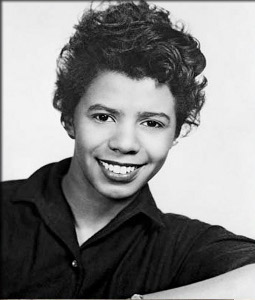
“No alternative except our going in the streets … and chaos.”
“This boy,” Lena Horne said afterward, “just put it like it was. He communicated the plain, basic suffering of being a Negro. The primeval memory of everyone in that room went to work after that. … He took us back to the common dirt of our existence and rubbed our noses in it. … You could not encompass his anger, his fury, in a set of statistics, nor could Mr. Belafonte and Dr. Clark and Miss Horne, the fortunate Negroes, keep up the pretense of being the mature, responsible spokesmen for the race.” Lorraine Hansberry said to Kennedy, “Look, if you can’t understand what this young man is saying, then we are without any hope at all because you and your brother are representatives of the best that a white America can offer; and if you are insensitive to this, then there’s no alternative except our going in the streets … and chaos.” The whites, she said, were castrating the Negroes. She talked wildly about giving guns to Negroes in the street so they could start killing white people.
Kennedy said, as he had before, that his grandparents had encountered discrimination and now, two generations later, his brother was President; a Negro would be president within forty years. Baldwin replied furiously, “Your family had been her for three generations. My family has been here far longer than that. Why is your brother at the top while we are still so far away? That’s the heart of the problem.” Kennedy tried to turn the conversation to statistics and legislation. “In that moment, with the situation in Birmingham the way it was,” said Lena Horne, “none of us wanted to hear figures and percentages and all that stuff. Nobody even cared about expressions of good will.”
Kennedy said he had come in search of ideas. Baldwin suggested that John Kennedy personally escort two black students whom Governor George Wallace was loudly threatening to bar from the University of Alabama. Robert Kennedy thought this theatrical posturing. … They denounced the FBI. Kennedy, who privately agreed, passed the question to Burke Marshall, who said that “special men” – that is, lawyers from the Civil Rights Division – went into areas where the Bureau seemed delinquent. This answer, said Clark, “produced almost hysterical laughter.” Birmingham came up. When Kennedy explained how closely he had worked with Dr. King, they jeered and cried, “That’s not true.”
Kenneth Clark: “It became really one of the most violent, emotional verbal assaults … that I had ever witnessed before or since.” Baldwin: “Bobby didn’t understand what we were trying to tell him … didn’t understand our urgency.” Kennedy: “They all seemed possessed. They reacted as a unit. It was impossible to make contact with any of them.” Clark: “Bobby became more silent and tense, and he sat immobile in the chair. He no longer continued to defend himself. He just sat, and you could see the tension and the pressure building in him.”
It went on for three hours; then suddenly stopped, out of sheer exhaustion. Two incidents as the meeting broke up increased Kennedy’s shock. Clarence Jones, King’s lawyer, drew Kennedy aside and said, “I just want to say that Dr. King deeply appreciates the way you handled the Birmingham affair.” Kennedy said, “You watched these people attack me over Birmingham for forty minutes, and you didn’t say a word. There is no point in your saying this to me now.” Harry Belafonte had tried to smooth things over earlier by mentioning to the group the hospitality he had enjoyed at Hickory Hill; after a time, he had fallen into an uncomfortable silence. Now he said to Kennedy, “Of course you have done more for civil right than anyone else.” Kennedy said, “Why do you say this to me? Why didn’t you say this to the others?” Belafonte said, “I couldn’t say this to the others. It would affect my position with these people, and I have a chance to influence them along a reasonable way. … If I sided with you on these matters then I would become suspect.”
The meeting shattered them all. Clark and Baldwin talked it over that night. “Our considered judgment,” Clark said, “was that the whole thing was hopeless; that there was no chance that Bobby heard anything that we said. … Kennedy was not unimpressive. He didn’t minimize or condescend. But he just didn’t seem to get it.” Clark told James Wechsler in a day or two, “The fact that Bobby Kennedy sat through such an ordeal for three hours proves that he is among the best the white power structure has to offer. … There were no villains in that room – only the past of our society.” That is what made it all seem so hopeless.
Kennedy said to me on his return to Washington, his voice filled with despair: “They don’t know what the laws are – they don’t know what the facts are – they don’t know what we’ve been doing or what we’re trying to do. You can’t talk to them the way you can talk to Martin Luther King or Roy Wilkins. They didn’t want to talk that way. It was all emotion, hysteria – they stood up and orated – they cursed – some of them wept and left the room.” I worried (as I noted) “that his final reaction would be a sense of the futility rather than of the urgency of trying to bridge the gap. He may have felt himself that I might have had this fear, because he called me later in the evening on another matter and seemed thoroughly calm.”
In subsequent months he tried to explain to himself why there had been this outburst against him. Of course the meeting was misconceived. He was interested in policy, the blacks, Clark and Berry apart, in witness. What Clark called the “excruciating sense of impasse” seemed inevitable. Guilt, Kennedy thought, was also a factor. “There was a complex about the fact that they had not been involved personally themselves, they were not suffering like Negroes were suffering. … You’ve seen it with white people … children of wealthy parents … who’ve got some social problem about where they stand in life … and therefore become extreme and difficult emotionally.”
But none of this could quite explain away the violent jolt he received that spring afternoon. He began, I believe, to grasp as from the inside the nature of black anguish. He resented the experience, but it pierced him all the same. His tormentors made no sense; but in a way they made all sense. It was another stage in education. Thirteen years later it remained for Kenneth Clark “the most intense, traumatic meeting in which I’ve ever taken part … the most unrestrained interchange among adults, head-to-head, no holds barred … the most dramatic experience I’ve ever had.”
* Also attending: Edward False, James Baldwin’s secretary; Baldwin’s brother, David; and Thais Aubrey, a friend of David Baldwin’s; the actor Rip Torn; Robert P. Mills; and Henry Morgenthau III, a television producer who was to tape an interview of Baldwin by Kenneth Clark later that afternoon.