MARK McGURL: “TRAPPED IN THE MIND OF AN IDIOT”
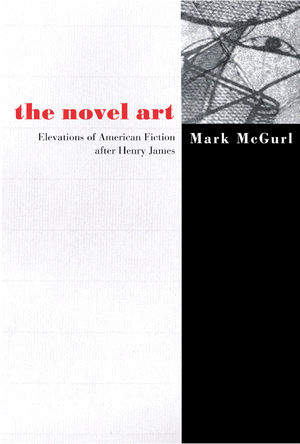
Excerpted from McGurl’s “Highbrows and Dumb Blondes,” The Novel Art: Elevations of American Fiction after Henry James:
 “I wanted Lorelei to be a symbol of the lowest possible mentality of our nation,” wrote Anita Loos of the heroine of her novel, Gentlemen Prefer Blondes: The Illuminating Diary of a Professional Lady (1925). That, Loos explained, is why she is said to have been born and raised in Little Rock, a backwater city in the region her friend H.L. Mencken had cruelly dubbed the ‘Sahara of the Bozart.’
…Lorelei’s hilariously breezy diary works, in another dimension, as a fairly rigorous narratological experiment in perspectival limitation. Since Lorelei’s is the only account we have of the events she describes, and since she is not conscious of her own intellectual limitations, the contempt that motivated Loos’s writing is present in her text only by implication. Lorelei’s friend Dorothy, in many ways a projection of Loos herself, might easily have been used as an ironic observer-narrator in the manner of Fitzgerald’s Nick Carraway in The Great Gatsby (1925). But her sarcastic commentary appears in the text only as reported by Lorelei, and intermittently at that. Mostly remain trapped in the mind of an idiot, and can only draw inferences as to what the intelligent version of her story might be.
 Lorelei’s “unreliability,” arising not from duplicity but stupidity, may be intended to place author and reader in a position of intellectual superiority to the story’s narrator – as, for instance, when we encounter many uncorrected misspellings in the text such as ‘for instants.’ And yet this ‘pathos of distance’ hovers remarkably close to a stream of discourse that continues to solicit the reader’s identification and sympathy. After all it is Lorelei’s simplicity, her innocent avarice and guileless guile, that seems to enable her triumph over the series of predatory males who patronize her. The entire effect, on Loos’s part, is of a kind of misogynist feminism: the valence of her somewhat vicious satire of a dumb blonde woman is partially reversed as it becomes the vehicle for an even stronger satire of ridiculous men. Speaking not about but through a female moron, Loos’s own authorial voice becomes subject to the rhetorical alternations, instabilities, and double entendres produced by what one might call its pastoral ventroloquism – a verbal form of what Lorelei calls, in another context, a ‘maskerade.’ …
Part of the complexity of Lorelei’s voice, as Susan Hegeman has suggested, might be attributed to Loos’s desire, from the standpoint of Hollywood, both to identify with and to spoof the intellectual pretensions of the New York literati. …
Entertaining the threat of widespread social indistinction, where the institutions of mass culture seem to act as a solvent of class difference, Gentlemen Prefer Blondes takes its place as one of several texts examined in this study that seem preoccupied, if here only satirically, by the problem of social indistinction and cultural leveling. …
The exemplary quality of the Gentlemen was first noted by Wyndham Lewis. Comparing it to Gertrude Stein’s avant-garde text Three Lives, Lewis criticized Loos’s use in Gentlemen of what he called the ‘naif-motif,’ seeing it as a symptom of the ‘affected naivety’ of an American literary ‘child-cult’ that he eloquently abhorred. …
Please add me to your mail list. I’m a retired Stanford employee and no longer have a Stanford ID that I know if. Thank you.
I’ve done so – but you don’t need a Stanford ID to participate, or be on our mailing list. “Another Look” is Stanford’s gift to the community.
Gotta love Stanford!!!! (And I DO!…)